Grammy Award for Best Country Collaboration with Vocals
The Grammy Award for Best Country Collaboration with Vocals was an honor presented at the Grammy Awards, a ceremony that was established in 1958 and originally called the Gramophone Awards,[1] to quality country music collaborations for artists who do not normally perform together.[2] Honors in several categories are presented at the ceremony annually by the National Academy of Recording Arts and Sciences of the United States to "honor artistic achievement, technical proficiency and overall excellence in the recording industry, without regard to album sales or chart position".[3]
| Grammy Award for Best Country Collaboration with Vocals | |
|---|---|
| Awarded for | quality country music collaborations with vocals |
| Country | United States |
| Presented by | National Academy of Recording Arts and Sciences |
| First awarded | 1988 |
| Last awarded | 2011 |
| Website | grammy.com |
Originally called the Best Country Vocal Performance, Duet, the award was first presented to Kenny Rogers and Ronnie Milsap at the 30th Grammy Awards in 1988 for the single "Make No Mistake, She's Mine". The next year, the category's name was changed to Best Country Vocal Collaboration, a name it held until 1996 when it was awarded as the Best Country Collaboration with Vocals. In 2011, the category was merged with the Grammy Award for Best Country Performance by a Duo or Group with Vocal and the Grammy Award for Best Country Instrumental Performance, forming the Grammy Award for Best Country Duo/Group Performance in order to "tighten the number of categories" at the Grammy Awards.[4]
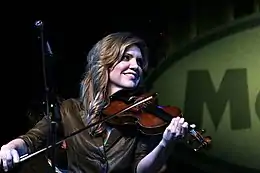
Alison Krauss holds the record for having the most wins in this category, with a total of five. She is followed by seven others, who have all won the award twice. Among the most nominated are Emmylou Harris and Willie Nelson, both nine-time nominees. Krauss was nominated eight times, while Dolly Parton was a seven-time hopeful. Nominated bands include 1996 winners Shenandoah, a five-man country music band, three-time nominees the Nitty Gritty Dirt Band, as well as one of the award's final recipients, the Zac Brown Band.
Recipients

.jpg.webp)

.jpg.webp)
| Year[I] | Performing artists | Work | Nominees | Ref. |
|---|---|---|---|---|
| 1988 | Ronnie Milsap with Kenny Rogers | "Make No Mistake, She's Mine" |
|
[5] |
| 1989 | Roy Orbison and k.d. lang | "Crying" |
|
[6] |
| 1990 | Hank Williams, Jr. with Hank Williams, Sr. | "There's a Tear in My Beer" |
|
[7] |
| 1991 | Chet Atkins and Mark Knopfler | "Poor Boy Blues" |
|
[8] |
| 1992 | Mark O'Connor with Vince Gill, Ricky Skaggs and Steve Wariner | "Restless" |
|
[9] |
| 1993 | Travis Tritt featuring Marty Stuart | "The Whiskey Ain't Workin'" |
|
[10] |
| 1994 | Reba McEntire with Linda Davis | "Does He Love You" |
|
[11] |
| 1995 | Aaron Neville and Trisha Yearwood | "I Fall to Pieces" |
|
[2] |
| 1996 | Shenandoah with Alison Krauss | "Somewhere in the Vicinity of the Heart" |
|
[12] |
| 1997 | Vince Gill featuring Alison Krauss & Union Station | "High Lonesome Sound" |
|
[13] |
| 1998 | Trisha Yearwood with Garth Brooks | "In Another's Eyes" |
|
[14] |
| 1999 | Clint Black, Joe Diffie, Merle Haggard, Emmylou Harris, Alison Krauss, Patty Loveless, Earl Scruggs, Ricky Skaggs, Marty Stuart, Pam Tillis, Randy Travis, Travis Tritt and Dwight Yoakam | "Same Old Train" |
|
[15] |
| 2000 | Emmylou Harris, Linda Ronstadt and Dolly Parton | "After the Gold Rush" |
|
[16] |
| 2001 | Faith Hill with Tim McGraw | "Let's Make Love" |
|
[17] |
| 2002 | Dan Tyminski, Pat Enright and Harley Allen (The Soggy Bottom Boys) | "I Am a Man of Constant Sorrow" |
|
[18] |
| 2003 | Willie Nelson with Lee Ann Womack | "Mendocino County Line" |
|
[19] |
| 2004 | James Taylor and Alison Krauss | "How's the World Treating You" |
|
[20] |
| 2005 | Loretta Lynn with Jack White | "Portland Oregon" |
|
[21] |
| 2006 | Faith Hill featuring Tim McGraw | "Like We Never Loved at All" |
|
[22] |
| 2007 | Bon Jovi with Jennifer Nettles of Sugarland | "Who Says You Can't Go Home" |
|
[23] |
| 2008 | Willie Nelson and Ray Price | "Lost Highway" |
|
[24] |
| 2009 | Robert Plant and Alison Krauss | "Killing the Blues" |
|
[25] |
| 2010 | Carrie Underwood featuring Randy Travis | "I Told You So" |
|
[26] |
| 2011 | Zac Brown Band featuring Alan Jackson | "As She's Walking Away" |
|
[27] |
^[I] Each year is linked to the article about the Grammy Awards held that year.
See also
- Grammy Award for Best Country Duo/Group Performance
- Grammy Award for Best Country Performance by a Duo or Group with Vocal
- Grammy Award for Best Country Solo Performance
- Grammy Award for Best Female Country Vocal Performance
- Grammy Award for Best Male Country Vocal Performance
References
- General
- "Past Winners Search". National Academy of Recording Arts and Sciences. Retrieved September 24, 2011. Note: User must select the "Country" category as the genre under the search feature.
- Specific
- "Grammy Awards at a Glance". Los Angeles Times. Retrieved April 24, 2010.
- "The 37th Grammy Nominations". Los Angeles Times. January 6, 1995. p. 4. Retrieved September 18, 2010.
- "Overview". National Academy of Recording Arts and Sciences. Archived from the original on October 27, 2009. Retrieved October 10, 2010.
- "Explanation For Category Restructuring". National Academy of Recording Arts and Sciences. Retrieved September 11, 2011.
- "U2 Up For 4 Grammys". The Charlotte Observer. January 15, 1988. p. 1B.
- "Nominees for music's best". USA Today. January 13, 1989. p. 5D.
- Jan DeKnock (February 16, 1990). "Who'll Win The Grammys? And the Grammy nominees are ...". Chicago Tribune. p. 37.
- "And the Grammy nominees are ...". Chicago Tribune. February 15, 1991. p. 28.
- "R.E.M., Adams Lead The Grammy Nomination Pack". Pittsburgh Post-Gazette. January 9, 1992. p. B3.
- Don McLeese (January 8, 1993). "Clapton leads Grammy nominations". Austin American-Statesman. p. 3.
- "Hundreds Nominated For Grammys". Deseret News. Deseret News Publishing Company. January 10, 1994. p. 3. Retrieved September 18, 2011.
- "The Complete List of Nominees". Los Angeles Times. January 5, 1996. p. 4. Retrieved July 13, 2010.
- "The Complete List of Nominees". Los Angeles Times. January 8, 1997. p. 2. Retrieved July 13, 2010.
- "1997 Grammy Nominees". Orlando Sentinel. January 9, 1998. p. 3. Retrieved July 13, 2010.
- "Academy's Complete List of Nominees". Los Angeles Times. January 6, 1999. p. 3. Retrieved July 13, 2010.
- Nielsen Business Media, Inc (2000). "Final Nominations For The 42nd Annual Grammy Awards". Billboard. 112 (3): 72. Retrieved September 11, 2011.
{{cite journal}}:|last1=has generic name (help) - Boucher, Geoff (January 4, 2001). "Grammys Cast a Wider Net Than Usual". Los Angeles Times. Archived from the original on May 14, 2012. Retrieved September 11, 2011.
- "Complete List Of Grammy Nominees". CBS. January 4, 2002. Archived from the original on October 10, 2003. Retrieved March 19, 2011.
- "Complete list of Grammy nominees; ceremony set for Feb. 23". San Francisco Chronicle. January 8, 2003. p. 3. Archived from the original on December 7, 2012. Retrieved March 19, 2011.
- "Grammy Award Winners". The New York Times. 2004. Retrieved March 11, 2011.
- "Grammy Award nominees in top categories". USA Today. February 7, 2005. Retrieved March 19, 2011.
- "The Complete List of Grammy Nominations". The New York Times. December 8, 2005. p. 2. Retrieved March 20, 2011.
- "Complete list of Grammy nominees". San Francisco Chronicle. December 8, 2006. p. 8. Archived from the original on November 6, 2012. Retrieved March 20, 2011.
- "The Complete List of Grammy Nominees". The New York Times. December 6, 2007. Retrieved March 20, 2011.
- "The 51st Annual Grammy Awards Nominations". CBS. Archived from the original on February 14, 2009. Retrieved September 10, 2011.
- "Nominees And Winners". National Academy of Recording Arts and Sciences. Retrieved March 20, 2011.
- "53rd Annual Grammy Awards nominees list". Los Angeles Times. Retrieved February 20, 2011.