Bayezid I
Bayezid I (Ottoman Turkish: بايزيد اول, Turkish: I. Bayezid), also known as Bayezid the Thunderbolt (Ottoman Turkish: یلدیرم بايزيد, Turkish: Yıldırım Bayezid; c. 1360 – 8 March 1403),[2] was the sultan of the Ottoman Empire from 1389 to 1402. He adopted the title of Sultan-i Rûm, Rûm being the Arabic name for the Eastern Roman Empire.[3] In 1394, Bayezid unsuccessfully besieged Constantinople.[4] He defeated the Crusaders at the Battle of Nicopolis in what is now Bulgaria in 1396. He was later defeated and captured by Timur at the Battle of Ankara in 1402 and died in captivity in March 1403, which triggered the Ottoman Interregnum.
| Bayezid I | |||||
|---|---|---|---|---|---|
| |||||
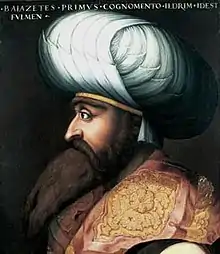 Bayezid I by Cristofano dell'Altissimo, c. 16th century | |||||
| Sultan of the Ottoman Empire (Padishah) | |||||
| Reign | 16 June 1389 – 20 July 1402 | ||||
| Predecessor | Murad I | ||||
| Successor | Interregnum (1402 – 1413)
| ||||
| Born | c. 1360 Ottoman Beylik | ||||
| Died | 8 March 1403 (aged 42) Akşehir, then under Timurid occupation | ||||
| Burial | Bayezid I Mosque, Bursa | ||||
| Consorts | Devlet Hatun Devletşah Hatun Despina Hatun Hafsa Hatun Others | ||||
| Issue | Süleyman Çelebi İsa Çelebi Mehmed I Musa Çelebi Mustafa Çelebi Others | ||||
| |||||
| Dynasty | Ottoman | ||||
| Father | Murad I | ||||
| Mother | Gülçiçek Hatun | ||||
| Religion | Sunni Islam | ||||
| Tughra |  | ||||
Biography
Bayezid was the son of Murad I[5] and his Greek wife, Gülçiçek Hatun.[6] His first major role was as governor of Kütahya, a city that he earned by marrying the daughter of a Germiyanid ruler.[7] He was an impetuous soldier, earning the nickname "Thunderbolt" in a battle against the Karamanids.
Bayezid ascended to the throne following the death of his father, Murad I, who was killed by Serbian knight Miloš Obilić during (15 June), or immediately after (16 June), the Battle of Kosovo in 1389, the battle in which Serbia became a vassal of the Ottoman Sultanate. Immediately after obtaining the throne, he had his younger brother strangled to avoid a plot. In 1390, Bayezid took as a wife Princess Olivera Despina, the daughter of Prince Lazar of Serbia,[8] who also lost his life in Kosovo. Bayezid recognized Stefan Lazarević, the son of Lazar, as the new Serbian leader - later despot - with considerable autonomy.

Upper Serbia resisted the Ottomans until Bayezid captured Skopje in 1391, converting the city into an important base of operations.
Efforts to unify Anatolia
Meanwhile, the sultan began unifying Anatolia under his rule. Forcible expansion into Muslim territories could have endangered the Ottoman relationship with the gazis, who were an important source of warriors for this ruling house on the European frontier. Thus Bayezid began the practice of first securing fatwas, or legal rulings from Islamic scholars, to justify wars against these Muslim states. However, Bayezid suspected the loyalty of his Muslim Turkish followers, so he relied heavily on his Serbian and Byzantine vassal troops in these conquests.[9]
In a single campaign over the summer and fall of 1390, Bayezid conquered the beyliks of Aydin, Saruhan and Menteshe. His major rival Sulayman, the emir of Karaman, responded by allying himself with the ruler of Sivas, Kadi Burhan al-Din and the remaining Turkish beyliks. Nevertheless, Bayezid pushed on and overwhelmed the remaining beyliks (Hamid, Teke, and Germiyan), as well as taking the cities of Akşehir and Niğde, as well as their capital Konya from the Karaman. At this point, Bayezid accepted peace proposals from Karaman (1391), concerned that further advances would antagonize his Turkoman followers and lead them to ally with Kadi Burhan al-Din. Once peace had been made with Karaman, Bayezid moved north against Kastamonu which had given refuge to many fleeing from his forces, and conquered both that city as well as Sinop.[10] However, his subsequent campaign was stopped by Burhan al-Din at the Battle of Kırkdilim.
From 1389 to 1395 he conquered Bulgaria and northern Greece. In 1394 Bayezid crossed the River Danube to attack Wallachia, ruled at that time by Mircea the Elder. The Ottomans were superior in number, but on 10 October 1394 (or 17 May 1395), in the Battle of Rovine, on forested and swampy terrain, the Wallachians won the fierce battle and prevented Bayezid's army from advancing beyond the Danube.[11]
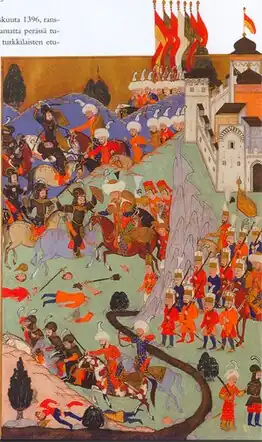
In 1394, Bayezid laid siege to Constantinople,[12] the capital of the Byzantine Empire. Anadoluhisarı fortress was built between 1393 and 1394 as part of preparations for the second Ottoman siege of Constantinople, which took place in 1395. On the urgings of the Byzantine emperor Manuel II Palaeologus, a new crusade was organized to defeat him. This proved unsuccessful: in 1396 the Christian allies, under the leadership of the King of Hungary and future Holy Roman Emperor (in 1433) Sigismund, were defeated in the Battle of Nicopolis. Bayezid built the magnificent Ulu Cami in Bursa, to celebrate this victory.
Thus the siege of Constantinople continued, lasting until 1402.[13] The beleaguered Byzantines had their reprieve when Bayezid fought the Timurid Empire in the east.[14] At this time, the empire of Bayezid included Thrace (except Constantinople), Macedonia, Bulgaria, and parts of Serbia in Europe. In Asia, his domains extended to the Taurus Mountains. His army was considered one of the best in the Islamic world.
Clash with Timur
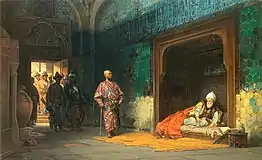
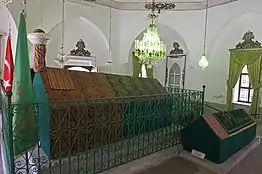
In 1397, Bayezid defeated the emir of Karaman in Akçay, killing him and annexing his territory. In 1398, the sultan conquered the Djanik emirate and the territory of Burhan al-Din, violating the accord with the Turco-Mongol emir Timur. Finally, Bayezid occupied Elbistan and Malatya.
In 1400, Timur succeeded in rousing the local Turkic beyliks who had been vassals of the Ottomans to join him in his attack on Bayezid, who was also considered one of the most powerful rulers in the Muslim world during that period. Years of insulting letters had passed between Timur and Bayezid. Both rulers insulted each other in their own way while Timur preferred to undermine Bayezid's position as a ruler and play down the significance of his military successes.
This is the excerpt from one of Timur's letters addressed to Ottoman sultan:
Believe me, you are but pismire ant: don't seek to fight the elephants for they'll crush you under their feet. Shall a petty prince such as you are contend with us? But your rodomontades [braggadocio] are not extraordinary; for a Turcoman never spoke with judgement. If you don't follow our counsels you will regret it.[15][16]
In the fateful Battle of Ankara, on 20 July 1402, the Ottoman army was defeated. Bayazid tried to escape, but was captured and taken to Timur.[17] Historians describe their first meeting as follows:
When Timur saw Bayezid, he laughed. Bayezid, offended by this laugh, told Timur that it was indecent to laugh at misfortune; to which Timur replied: "It is clear then that fate does not value power and possession of vast lands if it distributes them to cripples: to you, the crooked, and to me, the lame."[18]
Many writers claim that Bayezid was mistreated by the Timurids. However, writers and historians from Timur's own court reported that Bayezid was treated well, and that Timur even mourned his death.[19] One of Bayezid's sons, Mustafa Çelebi, was captured with him and held captive in Samarkand until 1405.
Four of Bayezid's sons, specifically Süleyman Çelebi, İsa Çelebi, Mehmed Çelebi, and Musa Çelebi, however, escaped from the battlefield and later started a civil war for the Ottoman throne known as the Ottoman Interregnum.[20] After Mehmed's victory, his coronation as Mehmed I, and the deaths of the other three, Bayezid's other son Mustafa Çelebi emerged from hiding and began two failed rebellions against his brother Mehmed and, after Mehmed's death, his nephew Murad II.
Family
Consorts
Bayezid I had at least six consorts:[22][23][24]
- Devlet Hatun (? – 23 January 1414). Slave concubine, mother of Mehmed I.
- Devletşah Sultan Hatun. Daughter of Süleyman of Germiyan and Mutahhare Abide Hatun, granddaughter of Rumi.
- Maria Olivera Despina Hatun (1372 – after 1444). Serbian princess, daughter of Prince Lazar of Serbia and Princess Miliza, she married Bayezid in 1390. Extremely unpopular with the Ottomans, she was accused of bribing the sultan and introducing alcohol to the court. She was captured by Timur together with her husband, and forced to serve him naked.
- Hafsa Hatun. Daughter of Prince Fahreddin Isa Bey of the Aydinids, she married Bayezid in 1390.
- Fülane Hatun. Daughter of Constantine of Kostendil. Her older sister married Murad I and an other her sister married Yakub Çelebi, son of Murad and half-brother of Bayezid.
- A daughter of John V Palaiologos and Helena Kantakouzene. Her older sister Maria married Murad I and an other her sister married Yakub Çelebi.
Sons
Bayezid I had at least eight sons:[25]
- Ertuğrul Çelebi; (1378–1400).
- Süleyman Çelebi (d. 1411). Sultan of Rumelia, claimant to the Ottoman throne (r. 1402–1411).
- İsa Çelebi (d. 1403) – with Devletşah Hatun. Governor of Anatolia, claimant to the Ottoman throne (r. 1403).
- Mehmed I (c. 1386–1421) – with Devlet Hatun. Governor of Anatolia, and later Ottoman Sultan.
- Musa Çelebi (1388–1413) – with Devletşah Hatun. Sultan of Rumelia (1410–1413), claimant to the Ottoman throne (1406–1413).
- Mustafa Çelebi (1393–1422). Sultan of Rumelia, claimant to the Ottoman throne (reign 1419–1422).
- Yusuf Çelebi. Converted to Christianity, changed his name to Demetrios.
- Kasım Çelebi. Sent as a hostage to Constantinople together with his sister, Fatma Hatun.
Daughters
Bayezid I had at least five daughters:[26]
- Fatma Hündi Hatun (1375–1430). She married to Seyyid Şemseddin Mehmed Buhari Emir Sultan in 1390 and she had four sons, Emir Ali and other three, and two daughters. Legend has it that Hundi and Seyyid were married in secret after having a vision of the Prophet Muhammad, and that Bayezid only accepted their marriage after a miracle saved his son-in-law from soldiers sent to kill him. According to another version, Seyyd, guest of Bayezid, took advantage of his absence from court to seduce Hundi and marry her.
- Erhundi Hatun. She married to Yakup Bey, son of Pars Bey.
- Fatma Hatun (1393–1417). She was sent as a hostage to Constantinople together with her brother, Kasim Çelebi. Later she married a sanjak-bey in 1413.
- Öruz Hatun – with Despina Hatun. She married Abu Bakar Mirza, son of Jalal ud-din Miran Shah, son of Timur. They had at least a daughter, Ayşe Hatun.
- Paşa Melek Hatun – with Despina Hatun. In 1403 she married Emîr Celaluddîn İslâm, a Timur's general.
Personality

According to the British orientalist, Lord Kinross, Bayezid was distinguished by haste, impulsivity, unpredictability and imprudence.[27] He cared little for state affairs, which he entrusted to his governors. As Kinross writes, between campaigns Bayezid was often engaged in pleasures: gluttony, drunkenness and debauchery. The courtyard of the sultan was famous for its luxury and was comparable to the Byzantine court during its heyday.[28]
At the same time, the sultan was a talented commander.[27] In all 13 years of his reign, Bayezid suffered only one defeat, which eventually turned out to be fatal for him.[29] Despite his lust for earthly pleasures, Bayezid was a religious man and used to spend hours in his personal mosque in Bursa. He also kept Islamic theologians in his circle.[30]
In the words of the contemporary Greek historian Doukas:[31]
[Bayezid] was a feared man, precipitate in deeds of war, a persecutor of Christians as no other around him, and in the religion of the Arabs a most ardent disciple of Muhammad, whose unlawful commandments were observed to the utmost, never sleeping, spending his nights contriving intrigues and machinations against the rational flock of Christ.... His purpose was to increase the nation of the Prophet and to decrease that of the Romans. Many cities and provinces did he add to the dominion of the Muslims.
Evaluation of rule
Bayezid managed to expand the territory of the Ottoman empire to the Danube and the Euphrates. However, his reign culminated with a humiliating defeat at Ankara, whereby the empire was reduced to the size of a beylik from the time of Orhan. This small territory was divided between Bayezid's two sons by Timur and many beyliks regained their independence. The defeat at Ankara marked the beginning of the Ottoman interregnum, which lasted 10 years.[17]
In popular culture
Sultan Bayezid was portrayed in the Serbian 1989 historical drama film Battle of Kosovo, as a participant of the Battle of Kosovo by actor Branislav Lečić, and in the Romanian historical drama Mircea (Proud heritage) by Ion Ritiu as a young Sultan who fought in the battles of Rovine, Nicopolis and Angora.
See also
- Amir Sultan
References
- Kemal Çiçek; Ercüment Kuran; Nejat Göyünç; Halil İnalcık; İlber Ortaylı; Güler Eren (2000). The Great Ottoman-Turkish Civilisation: Philosophy, science, and institutions. Yeni Türkiye. p. 31.
In the letter coming with the envoy, Sultan Bayezid I became pleased for it addressed him as "Sultanu'l-Guzat ve'l-Mücahidin" (The Sultan of Ghazis and Holy Warriors)...
- "Bayezid I - Ottoman sultan". britannica.com. Archived from the original on 2 April 2016.
- Peirce, Leslie P. (11 May 1993). The Imperial Harem: Women and Sovereignty in the Ottoman Empire. Oxford University Press. ISBN 978-0-19-508677-5. Archived from the original on 23 September 2017 – via Google Books.
- Mango, Cyril. The Oxford History of Byzantium. New York: Oxford UP, 2002. pp. 273–274
- Runciman, Steven The Fall of Constantinople. Cambridge: Cambridge University Press, p. 36
- Lowry, Heath W. (2003) The Nature of the Early Ottoman State. Albany, NY: State University of New York Press, p. 153
- Halil Inalcik. "Bayezid I". TDV.
- Halil Inalcik, "Bayezid I", The Encyclopedia of Islam, Vol. I, Ed. H.A.R. Gibb, J.H. Kramers, E. Levi-Provencal and J. Schacht, (Brill, 1986), 1118.
- Stanford Shaw, History of the Ottoman Empire and Modern Turkey (Cambridge: University Press, 1976), vol. 1 p. 30
- Shaw, History of the Ottoman Empire, vol. 1 pp. 30f
- John V.A. Fine, The Late Medieval Balkans, (The University of Michigan Press, 1994), 424.
- Mango, Cyril. The Oxford History of Byzantium. New York: Oxford UP, 2002. pp. 273–274
- Nancy Bisaha, Creating East And West: Renaissance Humanists And the Ottoman Turks, (University of Pennsylvania Press, 2004), 98.
- Dimitris J. Kastritsis, The Sons of Bayezid: Empire Building and Representation in the Ottoman Civil War of 1402–13, (Brill, 2007), 5.
- Sharaf al-Dīn ʻAlī Yazdī (1723). The History of Timur-Bec. J. Darby. p. 150.
- Rhoads Murphey, Exploring Ottoman Sovereignty: Tradition, Image and Practice in the Ottoman Imperial Household 1400–1800; published by Continium, 2008; p. 58
- Kinross, B.P; "Ottoman Centuries: The Rise and Fall of the Turkish Empire". 1999. pp. 86–88; ISBN 5-232-00732-7
- Ivanin M.I. On the art of war and the conquests of the Mongol-Tatars and Central Asian peoples under Genghis Khan and Tamerlane. St. Petersburg, 1875. p. 315.
- Meserve, Margaret (2009). Empires of Islam in Renaissance Historical Thought. Harvard University Press. ISBN 978-0-674-04095-3.
- Dimitris J. Kastritsis, 1–3.
- "Battle of Nicopolis (1396)" from Seyyid Lokman (1588): Hünernâme
- Köprülü, Mehmet Fuat (1966). Edebiyat araştırmaları. Türk Tarih Kurumu Basımevi. p. 76.
- Öztürk, Necdet (2014). Osmanlı Sosyal Hayati. Işık Yayıncılık Ticaret.
- Uluçay, M. Çağatay (1985). Padişahların kadınları ve kızları. Türk Tarih Kurumu. pp. 24–25.
- Kastritsis (2007, p. 41)
- Mustafa Çağatay Uluçay (2011). Padişahların kadınları ve kızları. Ankara, Ötüken. pp. 25–26.
- Kinross, B.P; "Ottoman Centuries: The Rise and Fall of the Turkish Empire". 1999. pp. 70–71; ISBN 5-232-00732-7
- Kinross, B.P; "Ottoman Centuries: The Rise and Fall of the Turkish Empire". 1999. p. 73 ISBN 5-232-00732-7
- Kinross, B.P; "Ottoman Centuries: The Rise and Fall of the Turkish Empire". 1999. pp. 82–85; ISBN 5-232-00732-7
- Kinross, B.P; "Ottoman Centuries: The Rise and Fall of the Turkish Empire". 1999. p. 73; ISBN 5-232-00732-7
- Decline and Fall of Byzantium to the Ottoman Turks. Wayne State University Press. 1975. ISBN 978-0-8143-1540-8.
Notes
Sources
- İnalcık, Halil (1960). "Bāyazīd". In Gibb, H. A. R.; Kramers, J. H.; Lévi-Provençal, E.; Schacht, J.; Lewis, B. & Pellat, Ch. (eds.). Encyclopaedia of Islam. Volume I: A–B (2nd ed.). Leiden: E. J. Brill. pp. 1117–1119. OCLC 495469456.
- Harris, Jonathan (2010) The End of Byzantium. New Haven and London: Yale University Press ISBN 978-0-300-11786-8
- Imber, Colin (2009). The Ottoman Empire, 1300–1650: The Structure of Power (2nd ed.). New York: Palgrave Macmillan. ISBN 978-0-230-57451-9.
- Kastritsis, Dimitris (2007). The Sons of Bayezid: Empire Building and Representation in the Ottoman Civil War of 1402–13. Brill. ISBN 978-90-04-15836-8.
- Nicolle, David (1999) Nicopolis 1396: The Last Crusade. Oxford: Osprey Books ISBN 978-1-85532-918-8
External links

| |
| |
§ First Ottoman caliph • §§ Caliph only
|

.svg.png.webp) Ottoman princes Ottoman princes | ||
|---|---|---|
| 1st generation |
| |
| 2nd generation |
| |
| 3rd generation |
| |
| 4th generation |
| |
| 5th generation |
| |
| 6th generation |
| |
| 7th generation |
| |
| 8th generation |
| |
| 9th generation |
| |
| 10th generation |
| |
| 11th generation |
| |
| 12th generation |
| |
| 13th generation |
| |
| 14th generation |
| |
| 15th generation |
| |
| 16th generation |
| |
| 17th generation |
| |
| 18th generation |
| |
| 19th generation |
| |
| 20th generation |
| |
| 21st generation |
| |
| 22nd generation |
| |
| 23rd generation |
| |