Disaster risk reduction
Disaster risk reduction (DRR) sometimes called disaster risk management (DRM) is a systematic approach to identifying, assessing and reducing the risks of disaster. It aims to reduce socio-economic vulnerabilities to disaster as well as dealing with the environmental and other hazards that trigger them. In other words, the aim of DRR is "to prevent new and reducing existing disaster risk and managing residual risk, all of which contribute to strengthening resilience and therefore to the achievement of sustainable development".[1]: 16
.jpg.webp)
Disaster risk reduction has been strongly influenced by the research on vulnerability since the mid-1970s[2] as well as the mapping of natural disaster risks.[3] Disaster risk reduction is the responsibility of development and relief agencies alike. It should be an integral part of the way such organizations do their work, not an add-on or one-off action. Disaster risk reduction is very wide-ranging: Its scope is much broader and deeper than conventional emergency management. There is potential for disaster risk reduction initiatives in most sectors of development and humanitarian work.
Internationally, an important initiative is the Sendai Framework for Disaster Risk Reduction. It aims to help countries establish national and local strategies for DRR; as of 2022, 125 countries had national strategies. The International Day for Disaster Risk Reduction, on October 13, has helped increase the visibility of DRR and promote a culture of prevention. Some of the main issues and challenges include the importance of communities and local organisations in disaster risk management, governance of disaster risk and how this relates to development, and gender sensitivity of disaster impacts and disaster prevention strategies.
Definition
Disaster risk reduction (DRR) is defined by United Nations Office for Disaster Risk Reduction (UNDRR) as those actions which am to "prevent new and reducing existing disaster risk and managing residual risk, all of which contribute to strengthening resilience and therefore to the achievement of sustainable development".[1]: 16
Development of the concept
From disaster management
.jpg.webp)
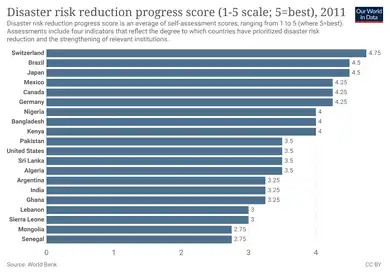
Disaster management thinking and practice since the 1970s has included more focus on understanding why disasters happen. It has also focused on actions that can reduce risk before a disaster occurs. This has put more emphasis on mitigation and preparedness in addition to the response and recovery phases of disasters. It has been widely embraced by governments, disaster planners and civil society organisations.[4]
DRR is such an all-embracing concept that it has proved difficult to define or explain in detail, although the broad idea is clear enough. It is generally understood to mean the broad development and application of policies, strategies and practices to minimise vulnerabilities and disaster risks throughout society. Its policy goals and objectives are defined in disaster risk reduction strategies and plans.[1]: 16
The term 'disaster risk management' (DRM) is often used in the same context and to mean much the same thing. That is, a systematic approach to identifying, assessing and reducing risks of all kinds associated with hazards and human activities. DRM is more properly applied to the operational aspects of DRR: the practical implementation of DRR initiatives.[5] In other words, disaster risk reduction is the policy objective of disaster risk management.[1]
Resilience
In disaster risk reduction, the concept of resilience expresses one goal of disaster prevention and response. Resilience refers to the ability of a community or society to preserve its essential structure and function in the face of stress and shocks. Resilience is closely connected to the concept of vulnerability, though resilience tends to be a higher, strategic goal of building social systems, while vulnerability is a tool for analyzing the properties of those systems.
The term resilience originates from the ecological sciences as a description of a system’s response to change, originally coming from the Latin resilire, “to bounce [back]”.[6] It was first used in the present sense by C.S. Holling in 1973, as a measure of the ability of relationships within a natural system to persist, i.e., for the organisms within the system to not go extinct.[7] Resilience in the ecological sense is not equilibrium: it differs from stability, the ability of a system to resist fluctuation. A system that is resilient, therefore, can undergo changes without losing its core structure and function. In the case of human systems, that function is survival and the necessities of life.
Within the field of disaster risk reduction, one widely-accepted definition of resilience comes from UNISDR: “The ability of a system, community or society exposed to hazards to resist, absorb, accommodate to and recover from the effects of a hazard in a timely and efficient manner, including through the preservation and restoration of its essential basic structures and functions.”[8]
The importance of resilience in disaster risk management can be seen from the centrality of the term in the 2005-2015 Hyogo Framework for Action, which was subtitled “Building the Resilience of Nations and Communities to Disasters.” Building resilience, therefore, is currently understood as the goal of disaster risk reduction.[9]
Climate change adaptation
| Part of a series on |
| Climate change and society |
|---|
|


Climate change, through rising temperatures, changing rainfall patterns, and increasing sea levels, affects the nature of hydro meteorological hazards that can give rise to a disaster. Examples of such hazards are droughts, floods, and cyclones. Research on climate change adaptation has been ongoing since the 1990s.[10] : 167
Climate change contributes to disaster risk. So experts sometimes see climate change adaptation as one of many processes within disaster risk reduction.[11] In turn, disaster risk reduction is part of the broader consideration of sustainable development. Climate change adaptation and disaster risk reduction have similar goals (to reduce potential impacts of hazards and increase the resilience of people at risk). They use similar concepts and are informed by similar sources and studies.[12]
Disasters are often triggered by natural hazards. A natural event such as a fire or flood is not of itself a disaster: it's only when it affects people or is caused by them that is counts as a disaster. It is argued that natural disasters are always linked to human action or inaction or rooted in anthropogenic processes. Disasters, economic loss and the underlying vulnerabilities that drive risk are increasing. Global risks like climate change are having major impacts everywhere.[13] Scientists forecast climate change will increase the frequency and severity of extreme weather events and disasters. So adaptation may include measures to increase preparedness and relevant disaster response capacities.Sustainable development
Disaster risk reduction and management can be an integral part of sustainable development planning. Sustainable development tries to find a balance between economic development, environmental protection, and social well-being. The Brundtland Report in 1987 defined sustainable development as "development that meets the needs of the present generation without compromising the ability of future generations to meet their own needs".[14][15]
An underlying process refers to the ability of disaster risk management to alter existing development trajectories as transformation, which “involve[s] fundamental changes in the attributes of a system, including value systems; regulatory, legislative, or bureaucratic regimes; financial institutions; and technological or biophysical systems”.[16] Transformation occurs as society learns. This learning includes building partnerships, which helps to increase local capacity and contribute to institutional change. This in turn allows society to continually move from vulnerability, adaptation and development to resilience.[17]
DRR is an important area of work for several of the UN Sustainable Development Goals (SDGs). In particular it is one of the means of implementation targets for SDG11. This is Target 11.b: "Implement policies for inclusion, resource efficiency and disaster risk reduction".
International policies
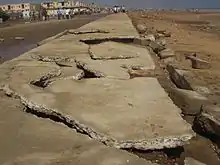
There have been growing calls for greater clarity about the components of DRR and about indicators of progress toward resilience — a challenge that the international community took up at the UN's World Conference on Disaster Reduction (WCDR) in Kobe, Japan, in 2005, only days after the 2004 Indian Ocean earthquake. The WCDR began the process of pushing international agencies and national governments beyond the vague rhetoric of most policy statements and toward setting clear targets and commitments for DRR.
Hyogo Framework for Action
The first step in this process was the formal approval at the WCDR of the Hyogo Framework for Action (2005–2015) (HFA). This was the first internationally accepted framework for DRR. It set out an ordered sequence of objectives (outcome – strategic goals – priorities), with five priorities for action attempting to 'capture' the main areas of DRR intervention. The UN's biennial Global Platform for Disaster Risk Reduction provided an opportunity for the UN and its member states to review progress against the Hyogo Framework. It held its first session 5–7 June 2007 in Geneva, Switzerland, where UNISDR is based. The subsequent Global Platforms were held in June 2009, May 2011 and May 2013, all in Geneva.
Sendai Framework for Disaster Risk Reduction
The Sendai Framework places the responsibility of reducing disaster risk primarily on federal governments through seven targets divided into two categories: substantial reductions and increases. It aims to reduce disaster mortality, people affected, economic loss, and damage to infrastructure and services. The remaining targets work to increase access to warning systems, aid to developing countries, and the number of countries with disaster risk reduction strategies.[18] Since the adoption of the Sendai Framework in 2015, the number of countries with national DRR strategies has increased dramatically, from 55 to 123 countries in 2022.[19]: 22
The framework also details four priorities for action to be accomplished by 2030:
- Understanding disaster risk
- Strengthening disaster risk governance
- Investing in disaster risk reduction
- Enhancing disaster preparedness [18]
These priorities acknowledge current shortcomings of DRR efforts, such as the lack of communication between local and federal governments and private programs, as well inequities faced by women and people with disabilities in the realm of disaster response.
Other international initiatives
UN initiatives have helped to refine and promote the concept at international level, stimulated initially by the UN's designation of the 1990s as the "International Decade for Natural Disaster Reduction". In 1999, UN member states approved the International Strategy for Disaster Risk Reduction, which reflected a shift from the traditional emphasis on disaster response to disaster reduction, by seeking to promote a "culture of prevention". In a further step to promote a global culture of disaster risk reduction the United Nations General Assembly designated an international day, which is now known as the International Day for Disaster Risk Reduction on every October 13th.[23] This day is an international day that encourages every citizen and government to take part in building more disaster-resilient communities and nations. The day was part of the UN's proclamation of the International Decade for Natural Disaster Reduction.[23] In 2009, the UN General Assembly changed the name to International Day for Disaster Reduction.[24]
Disaster risk is an indicator of poor development, so reducing disaster risk requires integrating DRR practice into the 17 Sustainable Development Goals. Decision makers need to manage risks, not just disasters.[25]
Cost and financing
Economic costs of disasters are on the rise, but most humanitarian investment is currently spent on responding to disasters, rather than managing their future risks. Only 4% of the estimated $10 billion in annual humanitarian assistance is devoted to prevention (source), and yet every dollar spent on risk reduction saves between $5 and $10 in economic losses from disasters.[26] A case study of Niger showed positive cost and benefit results for preparedness spending across 3 different scenarios (from the absolute level of disaster loss, to the potential reduction in disaster loss and the discount rate), estimating that every $1 spent results in $3.25 to $5.31 of benefit.[27]
There has been an increase in the economic losses from weather- and climate-related disasters, which contributed to $165 billion of economic losses worldwide in 2018 according to estimates from insurance giant Swiss Re.[28]
Issues and challenges
Communities and their organizations
Traditional emergency management/civil defense thinking makes two misleading assumptions about communities. First, it sees other forms of social organisation (voluntary and community-based organisations, informal social groupings and families) as irrelevant to emergency action. Spontaneous actions by affected communities or groups (e.g., search and rescue) are viewed as irrelevant or disruptive, because they are not controlled by the authorities. The second assumption is that disasters produce passive 'victims' who are overwhelmed by crisis or dysfunctional behavior (panic, looting, self-seeking activities). They therefore, need to be told what to do and their behavior must be controlled — in extreme cases, through the imposition of martial law. There is plenty of sociological research to refute such 'myths'.[29][30]
An alternative viewpoint, informed by a considerable volume of research , emphasises the importance of communities and local organisations in disaster risk management. The rationale for community-based disaster risk management that it responds to local problems and needs, capitalises on local knowledge and expertise, is cost-effective, improves the likelihood of sustainability through genuine 'ownership' of projects, strengthens community technical and organisational capacities, and empowers people by enabling them to tackle these and other challenges. Local people and organisations are the main actors in risk reduction and disaster response in any case.[31] Consequently, it has been seen that understanding the social capital already existent in the community can greatly help reducing the risk at the community level.[32][33]
Governance
In most countries, risk management is decentralized to local governments. In urban areas, the most widely used tool is the local development plan (municipal, comprehensive or general plan), followed by emergency and risk reduction plans that local governments are required to adopt by law and are updated every 4–5 years. Larger cities prefer stand-alone plans, called, depending on the context, sustainable, mitigation, or green plans. In rural areas, the mainstreaming of risk reduction policies into municipal (county or district) development plans prevails.[34] In many contexts, especially South of the Sahara, this process clashes with the lack of funds or mechanisms for transferring resources from the central to the local budget. Too often plans do not integrate local, scientific and technical knowledge. Finally, they entrust the implementation of policies to individual inhabitants without having fully involved them in the decision-making process. The authentic representativeness of the communities and gender participation in the decision-making process still remain an objective of the local development plans instead of being the way to build them.[35]
Gender
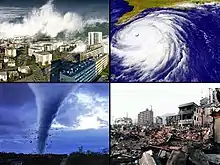
Disaster risk is not gender-neutral. Studies have shown that women and girls are disproportionately impacted by disasters. Following the 2004 tsunami in the Indian Ocean, 77% and 72% of the deaths in the districts of North Aceh and Aceh Besar, Indonesia, were female. And in India 62% of people who died were female.[36] This is due to socially-constructed gender roles that determine what norms and behaviors are acceptable for women and men, and girls and boys. In particular, women tend to take responsibility for home-based tasks and can be reluctant to leave their assets in the case of hazard warning; and often do not learn survival skills that can help in disasters, such as learning to swim or climb.
A gender-sensitive approach would identify how disasters affect men, women, boys and girls differently and shape policy that addresses people's specific vulnerabilities, concerns and needs.[37]
Examples
Bangladesh
Based on the Climate Risk Index,[38] Bangladesh is one of the most disaster-prone countries in the world. Bangladesh is highly vulnerable to different types of disasters because of climatic variability, extreme events, high population density, high incidence of poverty and social inequity, poor institutional capacity, inadequate financial resources, and poor infrastructure.[39] Bangladesh commenced its disaster preparedness following the cyclone of 1991 and has now a comprehensive National Plan for Disaster Management which provides mechanisms at both national and sub-national levels.[40]
European Union

In addition to providing funding to humanitarian aid, the European Commission's Directorate-General for European Civil Protection and Humanitarian Aid Operations (DG-ECHO) is in charge of the EU Civil Protection Mechanism [41] to coordinate the response to disasters in Europe and beyond and contributes to at least 75% of the transport and/or operational costs of deployments. Established in 2001, the Mechanism fosters cooperation among national civil protection authorities across Europe. Currently 34 countries are members of the Mechanism; all 27 EU Member States in addition to Iceland, Norway, Serbia, North Macedonia, Montenegro, Turkey and Bosnia and Herzegovina. The Mechanism was set up to enable coordinated assistance from the participating states to victims of natural and man-made disasters in Europe and elsewhere.
See also
- Business continuity planning
- Center for Natural Hazards Research
- Emergency management
- Global catastrophic risk
- International Day for Disaster Reduction
- Risk management
- Vulnerability
- Hazard map
References
- UNGA (2016). Report of the open-ended intergovernmental expert working group on indicators and terminology relating to disaster risk reduction. United Nations General Assembly (UNGA).
- Blaikie, Piers; Cannon, Terry; Davis, Ian; Wisner, Ben (2004). At Risk: Natural hazards, people's risk and disasters (2nd ed.). London: Routledge. ISBN 9780415252157.
- Shi, Peijun; Kasperson, Roger, eds. (2015). "World Atlas of Natural Disaster Risk". IHDP/Future Earth-Integrated Risk Governance Project Series. doi:10.1007/978-3-662-45430-5. ISBN 978-3-662-45429-9. ISSN 2363-4979. S2CID 199492512.
- § UN ISDR 2004, Living with Risk: A global review of disaster reduction initiatives (Geneva: UN International Strategy for Disaster Reduction),
- "Disaster Risk Reduction (DRR)". WMO Community Platform. World Meteorological Organization (WMO). n.d. Retrieved May 29, 2022.
Disaster risk management (DRM) comprises processes and actions to achieve [DRR] objective[s]
- Alexander, D.E. (2013). "Resilience and disaster risk reduction: an etymological journey". Natural Hazards and Earth System Sciences. 13 (11): 2707–2716. Bibcode:2013NHESS..13.2707A. doi:10.5194/nhess-13-2707-2013.
- Holling, C.S. (1973). "Resilience and stability of ecological systems" (PDF). Annual Review of Ecology and Systematics. 4: 1–23. doi:10.1146/annurev.es.04.110173.000245. S2CID 53309505.
- United Nations International Strategy for Disaster Reduction. (2009). 2009 UNISDR terminology on disaster risk reduction. United Nations.
- UNISDR. (2012) Towards a post-2015 framework for disaster risk reduction. United Nations Office for Disaster Risk Reduction.
- Ara Begum, R., R. Lempert, E. Ali, T.A. Benjaminsen, T. Bernauer, W. Cramer, X. Cui, K. Mach, G. Nagy, N.C. Stenseth, R. Sukumar, and P. Wester, 2022: Chapter 1: Point of Departure and Key Concepts. In: Climate Change 2022: Impacts, Adaptation and Vulnerability. Contribution of Working Group II to the Sixth Assessment Report of the Intergovernmental Panel on Climate Change [H.-O. Pörtner, D.C. Roberts, M. Tignor, E.S. Poloczanska, K. Mintenbeck, A. Alegría, M. Craig, S. Langsdorf, S. Löschke, V. Möller, A. Okem, B. Rama (eds.)]. Cambridge University Press, Cambridge, UK and New York, NY, USA, pp. 121–196, doi:10.1017/9781009325844.003.
- Kelman, Ilan; Gaillard, J C; Mercer, Jessica (March 2015). "Climate Change's Role in Disaster Risk Reduction's Future: Beyond Vulnerability and Resilience". International Journal of Disaster Risk Science. 6 (1): 21–27. doi:10.1007/s13753-015-0038-5. ISSN 2095-0055.
- "Managing the Risks of Extreme Events and Disasters to Advance Climate Change Adaptation — IPCC". Retrieved 2022-11-16.
- Global Assessment Report on Disaster Risk Reduction 2022. Our world at risk transforming governance for a resilient future. Geneva: United Nations Office for Disaster Risk Reduction. 2022. ISBN 978-92-1-232028-1. OCLC 1337569431.
- United Nations General Assembly (1987) Report of the World Commission on Environment and Development: Our Common Future Archived 31 March 2022 at the Wayback Machine. Transmitted to the General Assembly as an Annex to document A/42/427 – Development and International Co-operation: Environment.
- United Nations General Assembly (20 March 1987). "Report of the World Commission on Environment and Development: Our Common Future; Transmitted to the General Assembly as an Annex to document A/42/427 – Development and International Co-operation: Environment; Our Common Future, Chapter 2: Towards Sustainable Development; Paragraph 1". United Nations General Assembly. Retrieved 1 March 2010.
- "Toward a Sustainable and Resilient Future" (PDF). Retrieved Nov 27, 2020.
- Gall, M., S.L. Cutter and K. Nguyen (2014). "Transformative Development and Disaster Risk Management" (PDF). Retrieved Nov 27, 2020.
{{cite web}}: CS1 maint: multiple names: authors list (link) - "What is the Sendai Framework for Disaster Risk Reduction?". United Nations Office for Disaster Risk Reduction. Retrieved October 12, 2022.
- UNDRR (2023). The Report of the Midterm Review of the Implementation of the Sendai Framework for Disaster Risk Reduction 2015–2030. UNDRR: Geneva, Switzerland.
- Rowling, Megan (2015-03-18). "New global disaster plan sets targets to curb risk, losses | Reuters". Reuters. Retrieved 2016-01-13.
- "Sendai 2015: a new global agreement on disaster risk reduction | Overseas Development Institute". ODI. Retrieved 2016-01-13.
- "Many Disaster-related Meetings, Exhibitions to be Held". The Japan Times. 2015-03-14. Retrieved 2022-06-04.
- United Nations General Assembly Session 44 Resolution 236. International Decade for Natural Disaster Reduction A/RES/44/236 22 December 1989. Retrieved 2008-09-18.
- United Nations General Assembly Session 64 Resolution 200. International Strategy for Disaster Reduction A/64/200 21 December 2009. Retrieved 2011-10-14.
- "Disaster risk reduction & disaster risk management | PreventionWeb.net". www.preventionweb.net. Retrieved 2020-11-25.
- "A Needless Toll of Natural Disasters", Op-Ed, Boston Globe, 23 March 2006, by Eric Schwartz (UN Secretary General's Deputy Special Envoy for Tsunami Recovery
- Dare to prepare: taking risk seriously Kellett, J. and Peters, K. (2013) Overseas Development Institute. Retrieved 10 December 2013
- "Natural catastrophes and man-made disasters in 2018: "secondary" perils on the frontline" (PDF). SwissRe Institute SIGMA. 2019.
- § Quarantelli EL 1998, Major Criteria for Judging Disaster Planning and Managing and their Applicability in Developing Societies (University of Delaware: Disaster Research Center, Preliminary Paper 268).
- § Dynes RR 1994, 'Community Emergency Planning: False Assumptions and Inappropriate Analogies'. International Journal of Mass Emergencies and Disasters 12(2): 141–158.
- § Maskrey A 1989, Disaster Mitigation: A Community-Based Approach (Oxford: Oxfam).
- Aldrich, Daniel P.; Meyer, Michelle A. (February 2015). "Social Capital and Community Resilience". American Behavioral Scientist. 59 (2): 254–269. doi:10.1177/0002764214550299. S2CID 145471345.
- Sanyal, Saswata; Routray, Jayant Kumar (2016-08-27). "Social capital for disaster risk reduction and management with empirical evidences from Sundarbans of India". International Journal of Disaster Risk Reduction. 19: 101–111. Bibcode:2016IJDRR..19..101S. doi:10.1016/j.ijdrr.2016.08.010.
- Tiepolo, Maurizio (2017). Relevance and Quality of Climate Planning for Large and Medium-Sized Cities of the Tropics. Green Energy and Technology. Cham: Springer. pp. 199–226. doi:10.1007/978-3-319-59096-7_10. ISBN 978-3-319-59096-7.
- Tiepolo, Maurizio and Braccio, Sarah (2020). "Mainstreaming Disaster Risk Reduction into Local Development Plans for Rural Tropical Africa: A Systematic Assessment". Sustainability. 12 (2196): 2196. doi:10.3390/su12062196.
{{cite journal}}: CS1 maint: multiple names: authors list (link) - Neumayer, E and Plümper, T. (2007) 'The gendered nature of natural disastersL the impact of catastrophic events on the gender gap in making disaster risk reduction gender-sensitive: policy and practical guidelines life expectancy 1981–2002', Annals of the Association of American Geographers97(3): 551–566.
- Dr Virginie Le Masson and Lara Langston, Overseas Development Institute, March 2014, How Should the new international disaster risk framework address gender equality? http://cdkn.org/wp-content/uploads/2014/03/CDKN_Gender_DRR_PolicyBrief_Final_WEB.pdf
- Eckstein, David, V. Künzel, L. Schäfer and M. Winges (2019). "GLOBAL CLIMATE RISK INDEX 2020 Who Suffers Most from Extreme Weather Events? Weather-Related Loss Events in 2018 and 1999 to 2018" (PDF). Retrieved Nov 27, 2020.
{{cite web}}: CS1 maint: multiple names: authors list (link) - Shaw, Rajib; Islam, Aminul; Mallick, Fuad (2013), Shaw, Rajib; Mallick, Fuad; Islam, Aminul (eds.), "National Perspectives of Disaster Risk Reduction in Bangladesh", Disaster Risk Reduction Approaches in Bangladesh, Disaster Risk Reduction, Tokyo: Springer Japan, pp. 45–62, doi:10.1007/978-4-431-54252-0_3, ISBN 978-4-431-54252-0, retrieved 2020-11-27
- Government of the People’s Republic of Bangladesh Ministry of Disaster Management and Relief: National Plan for Disaster Management (2016-2020) Building Resilience for Sustainable Human Development
- "EU Civil Protection Mechanism". European Commission. Archived from the original on 2015-03-10. Retrieved 2021-07-28.
External links
- Ecosystem-based Disaster Risk Reduction
- Disaster Risk Management Society, GC University, Lahore.
- Asian Disaster Preparedness Center
- FAO – Platform for East and Central Africa
- EM-DAT: The International Disaster Database
- Global Facility for Disaster Reduction and Recovery
- United Nations Office for Disaster Risk Reduction
- Preventionweb – Building the resilience of nations and communities to disasters
- The World Bank, Hazards Management Unit
- United Nations Platform for Space-based Information for Disaster Management and Emergency Response
| Overview |
| ||||||||||||||||||||||||||||||||||||||||||||
|---|---|---|---|---|---|---|---|---|---|---|---|---|---|---|---|---|---|---|---|---|---|---|---|---|---|---|---|---|---|---|---|---|---|---|---|---|---|---|---|---|---|---|---|---|---|
| Disasters |
| ||||||||||||||||||||||||||||||||||||||||||||
| Preparation |
| ||||||||||||||||||||||||||||||||||||||||||||
| Countermeasures |
| ||||||||||||||||||||||||||||||||||||||||||||
| Media |
| ||||||||||||||||||||||||||||||||||||||||||||
| Organizations |
| ||||||||||||||||||||||||||||||||||||||||||||
| |||||||||||||||||||||||||||||||||||||||||||||
