Eastern European Summer Time
Eastern European Summer Time (EEST) is one of the names of the UTC+03:00 time zone, which is 3 hours ahead of Coordinated Universal Time. It is used as a summer daylight saving time in some European and Middle Eastern countries, which makes it the same as Arabia Standard Time, East Africa Time, and Moscow Time. During the winter periods, Eastern European Time (UTC+02:00) is used.
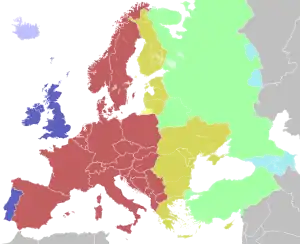
| Light Blue | Western European Time / Greenwich Mean Time (UTC) |
| Blue | Western European Time / Greenwich Mean Time (UTC) |
| Western European Summer Time / British Summer Time / Irish Standard Time (UTC+1) | |
| Red | Central European Time (UTC+1) |
| Central European Summer Time (UTC+2) | |
| Yellow | Eastern European Time / Kaliningrad Time (UTC+2) |
| Ochre | Eastern European Time (UTC+2) |
| Eastern European Summer Time (UTC+3) | |
| Green | Moscow Time / Turkey Time (UTC+3) |
| Turquoise | Armenia Time / Azerbaijan Time / Georgia Time / Samara Time (UTC+4) |
▉▉▉ Dark colours: Summer time observed
Since 1996, European Summer Time has been applied from the last Sunday in March to the last Sunday in October. Previously, the rules were not uniform across the European Union.[1]
Usage
The following countries and territories use Eastern European Summer Time during the summer:
- Belarus, Moscow Summer Time in years 1981–89, regular EEST from 1991-2011
- Bulgaria, regular EEST since 1979
- Cyprus, regular EEST since 1979 (Northern Cyprus stopped using EEST in September 2016, but returned to EEST in March 2018[2])
- Estonia, Moscow Summer Time in years 1981–88, regular EEST since 1989
- Egypt, since 2023
- Finland, regular EEST since 1981
- Greece, regular EEST since 1975
- Israel, Israel Daylight Time since 1948 (which tracks EEST when the two overlap)
- Jordan, since 1985
- Latvia, Moscow Summer Time in years 1981–88, regular EEST since 1989
- Lebanon, since 1984
- Lithuania, Moscow Summer Time in years 1981–88, regular EEST since 1989, apart from in years 1998-2003 when it was Central European Summer Time
- Moldova, Moscow Summer Time in years 1932–40 and 1981–89, regular EEST since 1991
- Romania, unofficial EEST in years 1932–40, regular EEST since 1979
- Russia (Kaliningrad), Moscow Summer Time in years 1981–90, regular EEST since 1991, as standard time from March 2011.
- Syria, since 1983
- Ukraine, Moscow Summer Time in years 1981–89, regular EEST from 1992[3]
In 1991, EEST was used also in Moscow and Samara time zones of Russia. Egypt has previously used EEST in 1957–2010 and 2014–2015. Turkey, has previously used EEST in 1970–1978, EEST and Moscow Summer Time in 1979–1983, and EEST in 1985–2016.
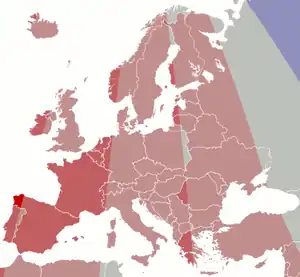
| Colour | Legal time vs. local mean time |
|---|---|
| 1 h ± 30 m behind | |
| 0 h ± 30 m | |
| 1 h ± 30 m ahead | |
| 2 h ± 30 m ahead | |
| 3 h ± 30 m ahead |
See also
- European Summer Time
- UTC+03:00
References
- Joseph Myers (2009-07-17). "History of legal time in Britain". Retrieved 2009-10-11.
- Time zones in North Nicosia
- Ukraine to return to standard time on Oct. 30 (updated), Kyiv Post (October 18, 2011)