Queensboro Bridge
The Queensboro Bridge, officially named the Ed Koch Queensboro Bridge, is a cantilever bridge over the East River in New York City. Completed in 1909, it connects the Long Island City neighborhood in the borough of Queens with the East Midtown and Upper East Side neighborhoods in Manhattan, passing over Roosevelt Island. The bridge is also known as the 59th Street Bridge because its Manhattan end is located between 59th and 60th streets.
Ed Koch Queensboro Bridge | |
|---|---|
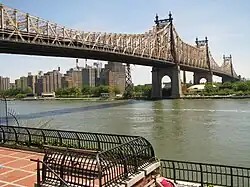 View from Manhattan towards Roosevelt Island in 2010 | |
| Coordinates | 40.757°N 73.955°W |
| Carries |
|
| Crosses | East River |
| Locale | New York City (Manhattan–Queens) |
| Other name(s) | Queensboro Bridge, 59th Street Bridge |
| Maintained by | New York City Department of Transportation |
| ID number | 2240048 |
| Characteristics | |
| Design | Double-decked cantilever bridge |
| Total length | 3,724 ft 6 in (1,135.2 m) |
| Width | 100 ft (30 m) |
| Height | 350 ft (110 m) |
| Longest span | 1,182 ft (360 m) (west span) |
| No. of spans | 5 |
| Clearance above | 12 ft (3.7 m) (upper level) |
| Clearance below | 130 ft (40 m) |
| History | |
| Architect | Henry Hornbostel |
| Designer | Gustav Lindenthal |
| Engineering design by | Leffert L. Buck |
| Opened | March 30, 1909 |
| Statistics | |
| Daily traffic | 160,111 (2019)[1] |
| Toll | Free |
Queensboro Bridge | |
New York State Register of Historic Places | |
New York City Landmark No. 0828 | |
| Architectural style | Beaux-Arts; through cantilever truss |
| NRHP reference No. | 78001879[2] |
| NYSRHP No. | 06101.000495 |
| NYCL No. | 0828 |
| Significant dates | |
| Added to NRHP | December 20, 1978 |
| Designated NYSRHP | June 23, 1980 |
| Designated NYCL | April 16, 1974 |
| Location | |

The Queensboro Bridge carries New York State Route 25 (NY 25), which terminates at the bridge's western end in Manhattan, and also once carried NY 24 and NY 25A. The western leg of the Queensboro Bridge is flanked on its northern side by the freestanding Roosevelt Island Tramway. The bridge was known as the Queensboro Bridge for 102 years, but in March 2011, it was officially renamed in honor of former New York City mayor Ed Koch.
The Queensboro Bridge is the northernmost of four toll-free vehicular bridges connecting Manhattan Island to Long Island, along with the Williamsburg, Manhattan, and Brooklyn bridges to the south. It is the first entry point into Manhattan in the course of the New York City Marathon and the last exit point out of Manhattan in the Five Boro Bike Tour.
Name
The Queensboro Bridge was originally named in honor of the borough of Queens, which, at the time of the bridge's construction in 1909, was largely rural. It was the third bridge across the East River to be named after a New York City borough, after the Brooklyn Bridge and the Manhattan Bridge.[3] By the late 20th century, the Queensboro Bridge was also known as the 59th Street Bridge, after its terminus in Manhattan. This name caused controversy among some Queens residents who felt that the 59th Street Bridge name did not honor the borough of Queens.[3][4]
On December 8, 2010, Mayor Bloomberg announced that the bridge would be renamed in honor of former mayor Ed Koch from the Queensboro Bridge to the Ed Koch Queensboro Bridge. The announcement was made the same week the New York State Legislature voted to rename the Brooklyn Battery Tunnel in honor of former Governor Hugh Carey.[5] The new name became official in March 2011.[6][7] The renaming decision was unpopular among Queens residents and business leaders, and many local residents continue to refer to the bridge by its older name.[8] New York City Council member Peter Vallone Jr. from Queens vowed to remove Koch's name from the bridge. Vallone said, "Never in a million years would they think to rename the Brooklyn or Manhattan bridges, but for some reason, it was OK to slap Queens around."[6]
Description
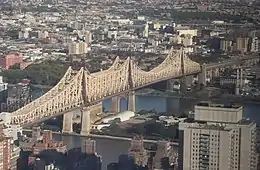
The Queensboro Bridge is a two-level double cantilever bridge, with separate cantilevered spans over channels on each side of Roosevelt Island joined by a fixed central truss.[9] In all it has five spans, including approaches between the cantilevered sections and each terminus. Their lengths are as follows:[10]
- Manhattan to Roosevelt Island span length (cantilever): 1,182 ft (360 m)
- Roosevelt Island span length: 630 ft (190 m)
- Roosevelt Island to Queens span length (cantilever): 984 ft (300 m)
- Manhattan approach span 469.5 ft (143.1 m)
- Queens approach span 459 ft (140 m)
- Total length between anchorages: 3,724 ft (1,135 m)
- Total length including approaches: 7,449 ft (2,270 m)
Until it was surpassed by the Quebec Bridge in 1917, the span between Manhattan and Roosevelt Island was the longest cantilever in North America.[11] The towers were originally surmounted by spires, but they were removed at some point in the 20th century because they were deteriorated.[12]
The New York Daily News wrote in 1981 that the Queensboro Bridge "reminds people of the bridges they built with erector sets as children".[13] Nonetheless, the bridge was not as widely appreciated as the Brooklyn Bridge further south, especially in the late 20th century.[14]
Levels
The upper level of the bridge has four lanes of automobile traffic, consisting of two roadways with two lanes in each directions. It provides a view of the bridge's cantilever truss structure and the New York skyline. Although the two upper level roadways both end at Thomson Avenue on the Queens side (with ramps to the Queens side), they diverge in opposite directions on the Manhattan side. The two lanes to the north, normally used by westbound traffic, lead to 62nd and 63rd Streets. The two lanes to the south, normally used by eastbound traffic, lead to 57th and 58th Streets. The southern roadway is used as a westbound high-occupancy vehicle lane during morning rush hours, when all eastbound traffic uses the lower level.[15]
The lower level has five vehicular lanes, the inner four for automobile traffic and the southern outer lane for automobile traffic as well, used exclusively for Queens-bound traffic. The North Outer Roadway was converted into a permanent pedestrian walk and bicycle path in September 2000.[16]
Manhattan approach
The Manhattan approach to the bridge is supported on a series of Guastavino tile vaults which formed the elegant ceiling of the former Food Emporium Bridge Market and the restaurant Guastavino's, located under the bridge. The inclusion of the space was part of Hornbostel's attempt to make the bridge more hospitable in the city.[17] The space under the Manhattan approach measures 120 by 270 feet (37 by 82 m) across[18][19] and is divided into a series of tiled vaults measuring 30 by 30 feet (9.1 by 9.1 m) across. As the bridge ascends to the east, the floor slopes down and the ceiling slopes up; as such, the ceiling measures 60 feet (18 m) high at its highest point.[19]
Historic usage
From the bridge's 1909 opening until the 1930s, the space under the Manhattan approach was used as a food market. During the Great Depression, the space was converted to a sign shop and garage.[18] By the 1970s, the space under the Manhattan approach was used by the Department of Highways.[19]
A developer proposed the open-air Bridgemarket under the bridge in 1976, which local residents significantly opposed.[20] Both the New York City Council and the Board of Estimate approved the market in 1977,[21] but a committee of the New York State Assembly blocked the plans.[22] The Bridgemarket plans were revived in 1981;[23] although local politicians supported the project, local residents opposed it.[24] This plan was again modified in 1986[25] and received approval from the New York City Landmarks Preservation Commission (LPC).[26] Work on Bridgemarket commenced in 1987[18] but was delayed again following local opposition.[27]
Bridgemarket, covering 98,000 square feet (9,100 m2), finally opened in 1999 at a cost of $24 million.[17] The store operated until the end of 2015.[28] In February 2020, it was announced that Trader Joe's was planning to open a supermarket in this space,[29] which opened in December 2021.[30][31]
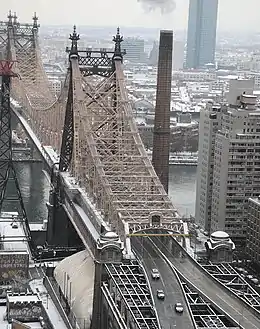 Looking east from Manhattan toward Queens
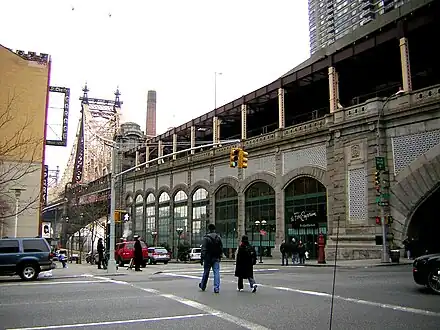 Bridgemarket on Manhattan side
History
Construction
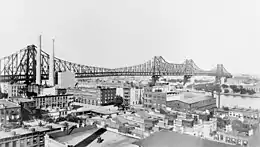
Prior to the construction of the Queensboro Bridge, two ferries connected Manhattan and Queens, neither of which were near the modern-day bridge. One such ferry connected Borden Avenue in Hunters Point, Queens, to 34th Street in Kips Bay, Manhattan, while the other ferry connected Astoria Boulevard in Astoria, Queens, with 92nd Street on Manhattan's Upper East Side.[13] Serious proposals for a bridge linking Manhattan to Long Island City were first made as early as 1838, and attempts to finance such a bridge were made by a private company beginning in 1867. Its efforts never came to fruition and the company went bankrupt in the 1890s.[32]
Successful plans finally came about in 1903 – after the creation in 1898 of Greater New York City through the amalgamation of Manhattan (New York City), Brooklyn, Queens, the Bronx and Staten Island[33] – under the new city's Department of Bridges, led by Gustav Lindenthal, who was appointed to the new position of Commissioner of Bridges in 1902, in collaboration with Leffert L. Buck and Henry Hornbostel, designers of the Williamsburg Bridge. Construction soon began, but it would take until 1909 for the bridge to be completed due to delays from the collapse of an incomplete span during a windstorm, and from labor unrest, which included an attempt to dynamite one span.
Opening and original configuration
The bridge opened for public use on March 30, 1909,[34] having cost about $18 million; fifty workers died during construction.[4] The bridge's ceremonial grand opening was held on June 12, 1909;[35] at the time, it was the fourth longest bridge in the world.[34] The grand opening included a fireworks display.[35] There was a ten-cent toll to drive over the bridge,[36] although pedestrians walked across for free. The bridge was then known as the Blackwell's Island Bridge, from an earlier name for Roosevelt Island.[37] The opening of the bridge encouraged development in Queens, including vehicle-manufacturing plants and other industrial structures in Long Island City.[13]
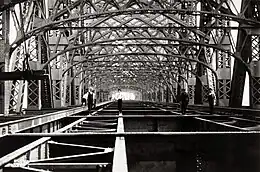
The bridge's upper level originally contained two pedestrian walkways and two elevated railway tracks (which connected a spur of the IRT Second Avenue Elevated Line in Manhattan to the Queensboro Plaza station in Queens).[34] Three lanes of roadway were installed on the south side of the upper level in 1931, replacing the former upper-level walkway.[38] All service on the Second Avenue Elevated was discontinued in 1942.[39]
The lower deck originally hosted four motor traffic lanes, and what is now the "outer roadway" and pedestrian walk were two trolley lanes.[34] A trolley connected passengers from Queens and Manhattan to a stop in the middle of the bridge, where passengers could take an elevator or the stairs down to Roosevelt Island.[40] In 1918[41] or 1919, an elevator building called the elevator storehouse was built adjacent to the bridge on the north side located about where the current tram station is to transport cars and passengers to what was then called Welfare Island, now Roosevelt Island. It was known as the "upside-down" building because its main entrance was on the 10th floor, the height of the bridge deck. This now-demolished building provided access to the hospitals on the island.[42][43]
1910s to 1940s
Shortly after the Queensboro Bridge opened, the city government conducted a study and found that it had no authority to charge tolls on the Queensboro and Manhattan bridges.[44] Tolls on all four bridges across the East River—the Queensboro Bridge, as well as the Williamsburg, Manhattan, and Brooklyn bridges to the south—were abolished in July 1911 as part of a populist policy initiative headed by New York City mayor William Jay Gaynor.[45][46]
The lower roadway of the Queensboro Bridge was originally composed of wooden pavers, as the bridge was intended to be used by horse-drawn carriages. With the increasing popularity of automobiles, the bridge became one of the city's most dangerous roads, as vehicles frequently skidded across the wooden blocks on rainy days. Between 1933 and 1936, thirteen people had died in accidents on the bridge, with 679 further injured; this prompted the city to repave the lower deck from 1935 to 1937.[47] By 1936, the bridge handled an average of 110,000 vehicles daily (with 80,000 between 7 a.m. and 7 p.m.).[48]
1950s and 1960s
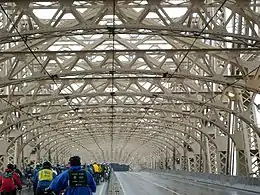
From 1955 to 1958, two additional lanes were built on the upper level. The upper-level ramps on the Queens end of the bridge were built during the same time.[49] In addition, the bridge's vehicular elevator closed after the Welfare Island Bridge from Queens opened in 1955, allowing automobile and truck access to Welfare Island and the only non-aquatic means in and out of the island.[43] The Queensboro Bridge trolley line operated until April 7, 1957,[50] and was the last trolley route in New York state.[51] The trolley lanes and mid-bridge station, as well as the stairs, were removed following the trolley's discontinuation.[42] A separate passenger elevator ran during weekdays[52] from near the Queens end of the bridge to Welfare Island, via a storehouse described as "clean but gloomy", until August 1973.[53]
Acting Manhattan borough president Louis A. Cioffi proposed a $2.06 million ramp on the Manhattan side of the bridge in 1960.[54] The same year, Consolidated Edison spent $4 million installing power cables under the former trolley tracks, converting the tracks into vehicular lanes, and installing emergency slip roads between the new lanes and the existing lower-level roadway.[55][56] The new lanes opened on September 15, 1960.[57] The city's Department of Public Works requested $200,000 in 1961 to determine the feasibility of adding more roadways to the Queensboro Bridge,[58] and the city's traffic commissioner Henry Barnes announced the next year that he was considering using computers to monitor traffic on the bridge.[59]
In 1964, mayor Robert F. Wagner Jr. approved the demolition of several buildings at the bridge's Manhattan terminus to make way for a $2.6 million underpass connecting the bridge's westbound lanes with southbound Second Avenue.[60] Had the underpass been built, a bus terminal and landscaped plaza would also have been erected at the Manhattan end of the bridge.[61] These plans were scrapped due to a lack of funding.[20] City planner Robert Moses proposed developing a 1,000-space parking garage with offices and a department store at the bridge's Manhattan end in 1965, though Barnes objected to the plan.[62][63] Instead, Barnes proposed a 1,100-spot garage on the Queens side,[64] which was approved in June 1966.[65] The bridge was repainted for seven months starting in November 1966 at a cost of $240,000.[66] Between 1968 and 1970, officials commissioned five studies of Queensboro Bridge traffic, but no changes were made as a result.[67]
1970s and 1980s
In 1970, the federal government enacted the Clean Air Act, a series of federal air pollution regulations.[68] As part of a plan by mayor John Lindsay and the federal Environmental Protection Agency,[69] the city government considered implementing tolls on the four free East River bridges, including the Queensboro, in the early 1970s.[70][71] The plan would have raised money for New York City's transit system[72] and allowed the city to meet the Clean Air Act.[69] Had the tolls been implemented, a tollbooth would have been installed on the bridge's Manhattan approach.[73] Around that time, a small terminal for express buses was proposed for the Manhattan end of the bridge.[74] New York City Center's Cinematheque leased space under the Queensboro Bridge in 1973,[75] although the Cinematheque never opened due to a lack of money.[76]
On November 23, 1973, the New York City Landmarks Preservation Commission (LPC) designated the Queensboro Bridge as a city landmark, preventing any modifications without the LPC's approval.[77][78] It was the second East River bridge to be so designated, after the Brooklyn Bridge.[78] While there were concerns that the landmark status could prevent tollbooths from being installed,[79] planners said the tollbooths could just be installed on the bridge's approaches.[78][80] The New York City Board of Estimate delayed ratification of the landmark designation because some space under the bridge's approaches was used for commercial purposes.[81] The tolling proposal was opposed by figures such as Queens borough president Donald Manes, who encouraged the state government to take over the bridge so tolls could not be charged.[82] According to Manes, the tolls would merely increase pollution around Queens Plaza.[83] Abraham Beame, who became mayor in 1974, refused to implement the tolls,[84] and the United States Congress subsequently moved to forbid tolls on the free East River bridges.[69]
By the mid-1970s, as the city government considered an open-air market under the bridge,[21][85] a city engineer described the bridge as severely deteriorated.[85][86] Among the issues cited were extensive rusting, faulty expansion joints, clogged drains, potholes, and dirt.[86] New York State Department of Transportation (NYSDOT) engineering director George Zaimes described the bridge's frame as being rusty, with some holes that were as large as a person's head. According to Zaimes, the upper roadway was only attached to the bridge "by its own weight and memory".[87]
Renovation
The state government started inspecting the Queensboro Bridge in 1978,[88] allocating $1.1 million for a study.[89] The city government also repainted the bridge[90] in a brown and tan color scheme.[91] To reduce congestion, a contraflow lane for express buses was installed at the Manhattan end of the bridge in 1979.[92] That year, the lower deck's outer lanes were closed to vehicles;[93][94] parts of the outer roadways had weakened to the point that they could barely carry the weight of a passenger car.[95] Repairs to the outer lanes were expected to last for three years[95] and cost $50 million.[96] The southern outer roadway was converted into a pedestrian and bicycle path,[94][95] which opened in July 1979.[97] The city received $18.6 million in federal funds for the Queensboro Bridge's restoration in 1980.[98] By then, an estimated 175,000 vehicles daily used the bridge.[13]
An extensive renovation commenced on February 25, 1981, with between three and six of the bridge's 11 lanes closed at any given time.[99] That December, the United States Department of Transportation gave $28.8 million for the bridge's renovation.[100] The pedestrian and bike path closed in May 1983.[47] The NYSDOT announced that July that the upper level's southern roadway, which carried eastbound traffic, would be closed for repairs, which were expected to take 18 months.[101][102] The northern roadway, normally used by westbound traffic. was converted to eastbound-only operation, except during weekday mornings when it carried westbound traffic.[101] The ramp leading from 57th and 58th Street to the southern upper roadway was temporarily closed for reconstruction in early 1984.[103] By the beginning of 1985, the southern upper roadway had reopened to traffic,[99] having cost $31 million to rehabilitate.[104] The outer lanes of the lower level had also reopened, but state officials estimated that the project would not be complete until 1992.[99]
The Queensboro Bridge's pedestrian path reopened in July 1985;[105] the same year, the city received another $60 million in federal funds for the renovations of the Queensboro, Manhattan, and Brooklyn bridges.[106] In February 1987, the New York City Department of Transportation announced that parts of the northern upper roadway would be closed for two years.[107] As part of the $42 million project, a new concrete deck would be installed, and the steel structure would be restored.[107] The ramps to 62nd and 63rd Street closed in October 1987[108] and reopened twelve months later.[104] This closure coincided with the renovations of other East River bridges.[109][110] To alleviate congestion, the lower-level bike path was opened to vehicular traffic at peak times,[109] and flatbed trucks carried bicycles across the bridge.[111] The lower deck's southern outer roadway was closed for emergency repairs in 1988 after workers discovered severe corrosion.[109] The reconstruction of the upper deck was completed in 1989 at a cost of $100 million.[112] The bridge was still in poor condition: during a tour of the bridge in 1988, transportation engineer Sam Schwartz was able to peel off part of one of the bridge's beams with one hand.[113]
1990s to present
A renovation of the Queensboro Bridge's lower level was to take place between 1990 and 1993.[113]
Starting in 1994, two lanes were reserved during rush hours for carpool traffic.[114] For a brief period in 1997, the traffic directions of the upper-level roadways were reversed during rush hours so that the upper level used a left-hand traffic pattern. Manhattan-bound traffic used the southern roadway while Queens-bound traffic used the northern roadway.[115] After residents of the Upper East Side voiced concerns about severe rush-hour congestion, this traffic pattern was discontinued, and the south-side walkway on the lower level was converted to a Queens-bound vehicular lane during the evening rush hour.[116] The outer roadway was later opened to vehicles at all times, but after a series of fatal crashes in 2013, officials decided to close the ramp during the nighttime.[117]
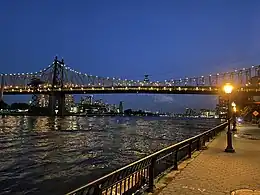
Mayor Michael Bloomberg again proposed tolling the four free East River bridges, including the Queensboro Bridge, in 2002; many local residents opposed his plan.[118] In March 2009, the New York City Bridge Centennial Commission sponsored events marking the centennial of the bridge's opening.[119] The bridge was also designated as a National Historic Civil Engineering Landmark by the American Society of Civil Engineers during the year of its centennial anniversary.[11] The bridge was renamed after Ed Koch in 2011.[6][7]
Mayor Bill de Blasio announced plans in April 2016 to allocate $244 million for repairs to the Queensboro Bridge's upper deck.[120] In January 2021, the city decided to install a two-way protected bike path on the northern outer roadway of the lower level, to be completed by 2022. The southern outer roadway, which at the time was used by vehicular traffic, would be used exclusively by pedestrians.[121][122] The conversion of the southern outer roadway was subsequently delayed because of a planned renovation of the upper deck.[123] The renovation commenced in February 2022 and was expected to last until December 2023.[124][125]
Public transportation
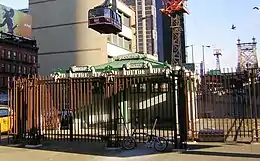
Rail tracks
In addition to the two elevated railway tracks, the bridge also had four streetcar tracks. The following Queens lines operated over the bridge:
- Queensboro Bridge Local, 1909–1957 (last streetcar line in the city)
- Astoria Line (Queens surface), 1910–1939
- Steinway Line, 1910–1939
- College Point Line, 1910–1925
- Corona Line (surface), 1910–1922
- Queens Boulevard Line (surface), 1913–1937
One Manhattan line operated over the bridge, the Third Avenue Railway's 42nd Street Crosstown Line from 1910 to 1950.
Buses
The bridge carries the Q32 local bus route operated by MTA New York City Transit and the Q60 and Q101 local bus routes operated by the MTA Bus Company. The bridge also carries 20 express bus routes in the eastbound direction only: the MTA Bus Company's QM1, QM2, QM3, QM4, QM5, QM6, QM10, QM15, QM16, QM17, QM18, QM20, QM21, QM24, QM31, QM32, QM34, QM35, QM36, QM40, QM42 and QM44, and New York City Transit's X63, X64, and X68. (These bus routes use the Queens-Midtown Tunnel for westbound travel.)[126]
In popular culture

.jpg.webp)
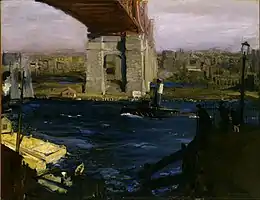
Because of its design and location, the Queensboro Bridge has appeared in numerous media works, including films and TV shows, set in New York City.[13]
Literature
- In F. Scott Fitzgerald's 1925 novel The Great Gatsby, Jay Gatsby and Nick Carraway traverse the bridge on their way from Long Island to Manhattan. "The city seen from the Queensboro Bridge," Nick says, "is always the city seen for the first time, in its first wild promise of all the mystery and the beauty in the world".[37]
- In E.B. White's 1952 novel Charlotte's Web, Charlotte tells Wilbur that the bridge took eight years to build, while she could have built a web in a night.
- In the climax of Truman Capote's 2005 novel Summer Crossing, the main character commits suicide and murders three passengers by crashing her car into the Queensboro Bridge.
- In the climax of Norm Macdonald's 2016 book Based on a True Story: Not a Memoir, Adam Eget (the co-host on his video podcast Norm Macdonald Live) is found making a handsome living underneath the Queensboro Bridge, jerking off punks for fifteen dollars a man; the joke is also repeated on Norm Macdonald Live.
Music
- The title of the Simon & Garfunkel 1966 song "The 59th Street Bridge Song (Feelin' Groovy)" refers to the Queensboro Bridge.[4][37] Harpers Bizarre covered the song in 1967, with the record rising to No. 13 on the US Billboard Hot 100 chart, making it the musical group's best-selling hit.
- An Australian group, The Seekers, covered the aforementioned Paul Simon song on their 1967 album Seekers Seen in Green.
- It is also cited in the Jack's Mannequin song "Diane, the Skyscraper," on the Dear Jack EP.
- It is also mentioned by rapper and Queensbridge native MC Shan in his song "The Bridge".
- It is the title of a track from the album Indiana by singer-songwriter David Mead.
Music videos
- Billy Joel's video for his 1985 single "You're Only Human (Second Wind)" was primarily filmed on the bridge.
- Pink Floyd's original video for "Us and Them" prominently features footage of the bridge.
- Pink Floyd's original video for "Money" also features footage of the bridge.
- The Queensbridge hip hop group Mobb Deep filmed the music video for "Shook Ones (Part II)" on the bridge.
Film
- In the 1932 Paramount Pictures light comedy film No Man of Her Own, starring Clark Gable and Carole Lombard, Lombard's character looks out of her hotel window to a view across the East River and the Queensboro Bridge, and refers to "Blackwell's Island", now known as Roosevelt Island.
- In the 1935 Movie After Office Hours Clark Gable and Constance Bennett star in "After Office Hours," a 1935 film directed by Robert Z. Leonard. Gable is Jim Branch, the go-getter editor of a newspaper, who is hot on the trial of a society love triangle.
- In the 1936 screwball comedy My Man Godfrey, the bridge is seen several times as the location of the city dump where the "forgotten men" live.
- The bridge is also the backdrop in the 1937 crime drama Dead End, directed by William Wyler, starring Sylvia Sidney, Joel McCrea, Humphrey Bogart, Wendy Barrie and Claire Trevor.
- In the 1948 film Sorry, Wrong Number, Leona Stevenson (Barbara Stanwyck) is an invalid. Through her open bedroom window we see the bridge with frequent trains crossing, and on the telephone she overhears a murder plot in which the killer tells someone that he will wait till the train is crossing the bridge "in case her window is open and she should scream."
- In the 1958 Warner Brothers' film Auntie Mame, the bridge serves as a backdrop for Mame Dennis' Beekman Place apartment.
- In the 1963 Universal film The Thrill of it All, obstetrician James Garner delivers Arlene Francis's baby on a traffic-jammed Queensboro Bridge.
- The bridge appears prominently in several scenes of the 1966 comedy film Any Wednesday, which starred Jane Fonda, Jason Robards, and Dean Jones.
- In Woody Allen's 1979 film Manhattan, the characters played by Allen and Diane Keaton relax on a bench in front of the bridge at dawn. The shot became the film's poster image.
- The final chase in the 1981 film Escape From New York takes place on the bridge. It is previously named by the President's kidnappers in a ransom note left in his briefcase in Central Park as where they'll release the President if their terms are met and by Issac Hayes's "Duke of New York" as what they'll cross the next day on their way to freedom with the kidnapped president leading them from the hood of the "duke"'s car..
- The climax of the 1985 film Turk 182! takes place on and around the Queensboro Bridge.
- The bridge is seen in the opening credits scene of the 1985 film Death Wish 3.
- In the 1991 film New Jack City, Nino Brown and the Duh Duh Man hang a man over the side of the bridge because of a drug debt he owes. Eventually they throw him off it to his death.
- In the 1992 family comedy film Home Alone 2: Lost in New York, the protagonist Kevin is seen taking a taxi over the bridge upon his entrance into New York City.
- In the 1993 romantic comedy film For Love or Money, the main protagonists Doug Ireland (Michael J. Fox) and Andy Hart (Gabrielle Anwar) reunite on opposite sides of the Queensboro Bridge and call out to each other on what they found out about unscrupulous billionaire Christian Hanover (Anthony Higgins).
- In the 1997 American action thriller film Conspiracy Theory, directed by Richard Donner, the bridge is crossed many times throughout the film.
- In the 2002 superhero film Spider-Man, the climax of the film where Spider-Man battles against his archenemy, the Green Goblin takes place around the bridge.
- In the 2003 slapstick comedy film Anger Management, Dave Buznik (Adam Sandler) and Dr. Buddy Rydell (played by Jack Nicholson), stop their car in the middle of the bridge to sing "I Feel Pretty".
- In the 2003 American comedy film Elf, when Buddy is ostracized by his father, he goes to the Queensboro Bridge to brood. It is from there that he sees Santa's sleigh out of control, on its way to Central Park.
- The 2010 movie Salt has a scene that takes place on, and was filmed on, the Queensboro Bridge.
- The 2012 film The Dark Knight Rises was filmed on the bridge.[127]
- In the 2013 movie Now You See Me, a car chase across the bridge leads to a crash in which the death of a character is faked.
- The bridge was featured in the 2014 film A Most Violent Year, in which there is an attempted hijacking of a fuel truck on it, followed by a short shootout and foot chase that leads down one of the bridge's service staircases. The bridge is referred to as the "59th Street Bridge" in the film.
- In the 2018 film Avengers: Infinity War, Peter Parker is on a school bus driving over the Queensboro Bridge. When he sees an alien spaceship over Manhattan, he changes into Spider-Man and exits the bus, swinging towards the spaceship.
Television/Online Video
- The Queensboro Bridge has been shown in the credits of the television series Archie Bunker's Place, The King of Queens, Rescue Me and Alphas. In addition, the opening sequence of Taxi depicts a Checker Taxi cab driving out of Manhattan on the upper deck of the bridge, and George and Louise Jefferson are shown riding in a taxi on the bridge's lower deck in the opening sequence of The Jeffersons.
- It is referred to in the opening theme of The King of Queens, in the line "...sitting here in traffic, on the Queensboro Bridge tonight."
- The bridge is taken over by a small army of Trolls in "Troll Bridge", the fifth episode of the first season of The Real Ghostbusters.
- The bridge is also referred to in The Simpsons 1996 episode "You Only Move Twice", when Hank Scorpio destroys it to show that he's not bluffing (though there is a possibility that the bridge collapsed on its own).
- An illustration of the bridge by Aurore Giscard d'Estaing is used in the main title of the A&E TV series A Nero Wolfe Mystery.
- A running joke on the video podcast Norm Macdonald Live involved host Norm Macdonald insinuating that straight man and co-host Adam Eget would "jerk off punks for fifteen dollars a man", an insinuation that was also in Macdonald's 2016 book Based on a True Story: Not a Memoir.[128]
Video games
- The bridge was destroyed in the video game Crysis 2 when a facility on Roosevelt Island exploded, causing the bridge to violently collapse.
- The bridge appears in the game Driver: Parallel Lines and is able to be traveled on foot or by car. During the mission "Kidnap" the player must blow up a billboard on the Manhattan side to block traffic.
- The bridge is part of the Nintendo DS game C.O.P.: The Recruit.
- The bridge appears in The Crew and The Crew 2.
- Joey refers to the bridge just having been finished when he was a kid in "Blackwell Unbound"
See also
- List of bridges documented by the Historic American Engineering Record in New York
References
Notes
- "NYC DOT - Data feeds". New York City Department of Transportation. 2019. NYC Bridge & Screenline Traffic Volumes Dashboard. Retrieved May 21, 2022.
- "National Register Information System – (#78001879)". National Register of Historic Places. National Park Service. July 9, 2010.
- "A Bridge by Any Other Name". Daily News. December 8, 1980. p. 277. Retrieved October 12, 2023.
- Colford, Paul D. (March 27, 1984). "Celebrating Bridge's 75th Year". Newsday. p. 9. Retrieved October 12, 2023.
- Bultman, Matthew & Fanelli, James (December 9, 2010). "Just call 59th Street Bridge the Ed Koch". New York Daily News. Archived from the original on December 10, 2010. Retrieved December 9, 2010.
{{cite news}}: CS1 maint: unfit URL (link) - Hernandez, Javier C. (March 23, 2011). "Council Votes to Rename Queensboro Bridge for Koch". The New York Times. Retrieved March 23, 2011.
- Einhorn, Erin (March 23, 2011). "Queensborough renamed in honor of Koch". New York Daily News. Retrieved March 27, 2018.
- Lisberg, Adam (February 28, 2011). "Queensboro Bridge should not be renamed after former Mayor Ed Koch, 70% of Queens biz leaders say". New York Daily News. Archived from the original on June 12, 2012. Retrieved February 28, 2011.
- "Project Page:2000 Biennial Bridge Inspection of the Queensboro Bridge over the East River". HAKS Corporation. Archived from the original on June 25, 2008. Retrieved June 15, 2008.
- Queensborough (59th Street) Bridge, nycroads.com
- "Queensboro Bridge". ASCE Metropolitan Section. Retrieved November 12, 2016.
- "The 8 Million". Daily News. December 25, 1960. p. 2. Retrieved October 11, 2023.
- Dallas, Gus (September 27, 1981). "Bridge Spans Time, Sentiment". Daily News. p. 254. Retrieved October 12, 2023.
- LaRosa, Paul (March 29, 1984). "Bridging the Gap: A Modest Gala". Daily News. p. 204. Retrieved October 12, 2023.
- "HOV Lanes". www.nyc.gov. Retrieved December 18, 2017.
- "Queensboro Bridge Rehabilitation Program". New York City Department of Transportation. Archived from the original on March 30, 2008. Retrieved March 13, 2010.
- Dunlap, David W. (March 7, 1999). "Bridgemarket Emerging, After 22 Years". The New York Times. Retrieved February 20, 2010.
- Sax, Irene (May 27, 1987). "Waiting for Bridgemarket Construction is about to start under the Queensborough Bridge". Newsday. p. 3. ISSN 2574-5298. ProQuest 277896828.
- "Design Notebook". The New York Times. August 4, 1977. ISSN 0362-4331. Retrieved October 12, 2023.
- "Residents Battling a Shopping Complex At Queensboro Bridge as Problem‐Prone". The New York Times. January 19, 1976. ISSN 0362-4331. Retrieved October 12, 2023.
- See:
- Kaiser, Charles (July 8, 1977). "Plans for $2 Million Open‐Air Market Under Queensboro Bridge Are Approved". The New York Times. ISSN 0362-4331. Retrieved October 12, 2023.
- "Board of Estimate Votes a New Lease For Bridgemarket". The New York Times. December 23, 1977. ISSN 0362-4331. Retrieved October 12, 2023.
- Ranzal, Edward (July 30, 1978). "Queensboro Bridge Market Plan Blocked by Assembly Committee". The New York Times. ISSN 0362-4331. Retrieved October 12, 2023.
- Purnick, Joyce (November 9, 1981). "Plan for Market Beneath Bridge Revived by City". The New York Times. ISSN 0362-4331. Retrieved October 12, 2023.
-
- For politicians' support, see: Haberman, Clyde (March 17, 1982). "Bridgemarket Plan Gets Local Officials' Backing". The New York Times. ISSN 0362-4331. Retrieved October 12, 2023.
- For residents' opposition, see: "Food-Complex Plan Found Hard to Digest". Daily News. December 18, 1981. pp. 124, 129. Retrieved October 12, 2023.
- Anderson, Susan Heller; Dunlap, David W. (May 28, 1986). "New York Day by Day; After 9 Years, Bridgemarket Plans Change". The New York Times. ISSN 0362-4331. Retrieved October 12, 2023.
- "The City; Bridgemarket Approved by Panel". The New York Times. July 10, 1986. ISSN 0362-4331. Retrieved October 12, 2023.
- Dunlap, David W. (June 7, 1989). "59th St. Bridge Market to Shrink a Bit". The New York Times. ISSN 0362-4331. Retrieved October 12, 2023.
- Levitt, David M (November 20, 2015). "Manhattan's Most Beautiful Supermarket Is Closing". Bloomberg.com. Retrieved October 12, 2023.
- Cohen, Michelle (February 26, 2020). "See the approved plans for Trader Joe's new Upper East Side store under the Queensboro Bridge". 6sqft. Retrieved August 12, 2022.
- Rahmanan, Anna (December 1, 2021). "The first Trader Joe's on the Upper East Side is officially opening tomorrow!". Time Out New York. Retrieved August 12, 2022.
- Saraiva, Augusta (December 2, 2021). "Manhattan's Most Beautiful Supermarket Reopens as a Trader Joe's". Bloomberg. Retrieved August 12, 2022.
- Queensboro Bridge (Historic Overview)
- Eldredge & Horenstein (2014), p.125
- Staff (March 31, 1909). "Queensboro Bridge Opens to Traffic" (PDF). The New York Times. p. 2. Retrieved February 20, 2010.
- Staff (June 13, 1909). "300,000 See Queens Linked to Old City" (PDF). The New York Times. p. 1. Retrieved February 20, 2010.
- "White Maps New Bridge; Issues Bulletin of Instructions for Reaching Structure". The New York Times. April 4, 1909. ISSN 0362-4331. Retrieved October 12, 2023.
- Barron, James (March 29, 2009). "To Fans, Queensboro Bridge Is a Steel Swan, Not an 'Ugly Duckling'". The New York Times. p. A22. Retrieved March 29, 2009.
- "Mayor Opens Deck on Queens Bridge; the Mayor Opens Another Bridge Remodeled for Traffic Needs" (PDF). The New York Times. June 26, 1931. ISSN 0362-4331. Retrieved December 18, 2017.
- "Manhattan East Side Transit Alternatives (MESA): Major Investment Study/Draft Environmental Impact Statement, August 1999". Metropolitan Transportation Authority, United States Department of Transportation, Federal Transit Administration. August 1999. Retrieved July 11, 2016.
- "Roosevelt Island Tramway". New York Correction History Society. Retrieved February 20, 2010.
- Bailey, Anthony (December 1, 1974). "Manhattan's other island". The New York Times. ISSN 0362-4331. Retrieved October 12, 2023.
- Eldredge & Horenstein (2014), p.126
- McCandlish, Phillips (April 7, 1957). "City's Last Trolley at End of Line; Buses Will Replace 49-Year Route on Queensboro Span" (PDF). The New York Times. p. 1. Retrieved August 17, 2008.
- "To Abolish Tolls On City Bridges; Mayor Gaynor Believes There Is No Legal Warrant for Taxing Vehicle Traffic". The New York Times. July 7, 1911. ISSN 0362-4331. Retrieved June 28, 2019.
- "Prize Fund for Atwood; Talk of One After Washington Commerce Chamber Refuses to Help". The New York Times. July 19, 1911. ISSN 0362-4331. Retrieved July 1, 2019.
- "Aldermen Abolish Tolls for Wagons on Bridges". Brooklyn Daily Eagle. July 18, 1911. p. 1. Retrieved July 1, 2019.
- "Closing of footpath provides a footnote". Daily News. June 19, 1983. p. 409. Retrieved October 12, 2023.
- Pierce, Bert (May 10, 1936). "Rail Removal and Resurfacing Streets Transforming New York Into City of Broad Boulevards". New York Herald Tribune. p. B3. ISSN 1941-0646. ProQuest 1330786511.
- Feron, James (1958). "QUEENS SPAN JOB NEAR COMPLETION; 2 Lanes and New Ramps on Queensboro Bridge Due to Be Finished in May" (PDF). The New York Times. ISSN 0362-4331. Retrieved December 18, 2017.
- Phillips, McCandlish (April 7, 1957). "City's Last Trolley at End of Line; Buses Will Replace 49-Year Route on Queensboro Span" (PDF). The New York Times. p. 1. Retrieved August 17, 2008.
- "P. S. C. Sounds a Requiem: Ends Trolley Car Rules". New York Herald Tribune. July 24, 1960. p. 3. ISSN 1941-0646. ProQuest 1325116113.
- Petroff, John (August 27, 1973). "Bridge Bits" (letter to the editor)". New York. p. 5. Retrieved March 7, 2015.
- Welch, Mary Scott (July 2, 1973). "Walking the City's Bridges". New York. p. 31. Retrieved March 7, 2015.
- Bennett, Charles G. (May 19, 1960). "25 Million in Roads Approved for City". The New York Times. ISSN 0362-4331. Retrieved October 11, 2023.
- "Queensboro Bridge Used by Con Ed for New Cables". New York Herald Tribune. August 10, 1960. p. 8. ISSN 1941-0646. ProQuest 1327212169.
- Ingraham, Joseph C. (August 10, 1960). "Con Ed Giving City Two Bridge Roads; Utility, in Paying $4,000,000 for Queensboro Lanes, Gets Route for Power Lines". The New York Times. ISSN 0362-4331. Retrieved October 11, 2023.
- "2 Bridge Lanes Added; Opened on Queensborough Span for Autos Only". The New York Times. September 16, 1960. ISSN 0362-4331. Retrieved October 11, 2023.
- Illson, Murray (August 23, 1961). "City Builds Colleges Too Slowly, Dr. Everett Tells Plan Board; Delay and Inefficiency Block Much-Needed Construction, Chancellor Declares". The New York Times. ISSN 0362-4331. Retrieved October 11, 2023.
- Stengren, Bernard (February 9, 1962). "Bridge Computer for Cars Studied; Plan to Cut Queensboro Jam Is Costly, Barnes Says". The New York Times. ISSN 0362-4331. Retrieved October 11, 2023.
- "Mayor Approves Razing on 2d Ave.; 11 Buildings Face Demolition for Bridge Underpass". The New York Times. November 8, 1964. ISSN 0362-4331. Retrieved October 11, 2023.
- O'Kane, Lawrence (March 13, 1965). "City Benefactor to Improve Plaza; Plans to Landscape Area off Queensboro Bridge". The New York Times. ISSN 0362-4331. Retrieved October 11, 2023.
- Kihss, Peter (March 8, 1965). "Moses Asks Garage At 59th St. Bridge; Plan Angers Barnes; Moses Proposes a Garage at Queensboro Bridge". The New York Times. ISSN 0362-4331. Retrieved October 10, 2023.
- "Moses Asks Garage & Barnes Burns Up". Daily News. March 8, 1965. p. 5. Retrieved October 11, 2023.
- Devlin, John C. (January 25, 1966). "Barnes Urges Queens Garage To Relieve Traffic in Manhattan". The New York Times. ISSN 0362-4331. Retrieved October 11, 2023.
- "Parking Garage in Queens Voted; 1,100-Car Facility Scheduled for Long Island City". The New York Times. June 25, 1966. ISSN 0362-4331. Retrieved October 11, 2023.
- "Painting Job Is Started On Queensboro Bridge". The New York Times. November 22, 1966. ISSN 0362-4331. Retrieved March 15, 2022.
- Tolchin, Martin (July 14, 1970). "Consultants Did 10 Bridge Studies: and None Was Implemented on Queensboro Since '48". The New York Times. ISSN 0362-4331. Retrieved October 12, 2023.
- Within, Richard (April 15, 1973). "Shift on Emission May Cost Drivers". The New York Times. ISSN 0362-4331. Archived from the original on August 29, 2017. Retrieved August 29, 2017.
- Dembart, Lee (June 16, 1977). "Broad Parking Ban in Manhattan Begins as Mayor Yields to Ruling". The New York Times. ISSN 0362-4331. Archived from the original on August 29, 2017. Retrieved August 28, 2017.
- Witkin, Richard (March 13, 1971). "City Bridge‐Toll Plans". The New York Times. ISSN 0362-4331. Retrieved March 29, 2022.
- "Bridge Toll Study". Newsday. April 22, 1970. p. 13. ISSN 2574-5298. ProQuest 916064041.
- "He Calls Toll on Bridges a Benefit to Straphangers". Daily News. May 24, 1971. p. 314. Retrieved October 12, 2023.
- "Study Says New Tolls Ridiculous". Newsday. April 30, 1977. p. 4. Retrieved October 12, 2023.
- Prial, Frank J. (December 8, 1971). "Network of Malls Urged By City for Midtown Area". The New York Times. ISSN 0362-4331. Retrieved October 12, 2023.
-
- "Cinematheque Gets Queensboro Site". The New York Times. November 2, 1973. ISSN 0362-4331. Archived from the original on March 5, 2023. Retrieved March 5, 2023.
- Oster, Jerry (November 26, 1973). "City Provides Fine Site for Film History". Daily News. p. 56. Archived from the original on March 5, 2023. Retrieved March 5, 2023.
-
- Prial, Frank J. (May 16, 1987). "Construction Date is Set at Stalled Bridgemarket". The New York Times. ISSN 0362-4331. Archived from the original on March 5, 2023. Retrieved March 5, 2023.
- "Film festival from Paris". Newsday. January 16, 1977. p. 107. Archived from the original on March 5, 2023. Retrieved March 5, 2023.
- "Landmark Status Given To Queensboro Bridge". The New York Times. November 24, 1973. ISSN 0362-4331. Retrieved March 29, 2022.
- "This Bridge to Wear A New Gold Plate". Daily News. November 24, 1973. p. 5. Retrieved March 29, 2022.
- Lieberman, Mark (September 26, 1973). "No Tollgate on a Bridge to the Past?". Daily News. p. 171. Retrieved March 29, 2022.
- "Formal Landmark Status Is Given to Central Park". The New York Times. May 10, 1974. p. 41. ISSN 0362-4331. ProQuest 120003956.
- Fowler, Glenn (February 10, 1974). "City Cites Boerum Hill". The New York Times. ISSN 0362-4331. Retrieved October 12, 2023.
- "Manes: 2 Toll-Free Ways Over Queensboro Bridge". Daily News. January 20, 1977. p. 560. Retrieved October 12, 2023.
- "Better Subways, Not Tolls Manes Pollution Solution". Daily News. February 25, 1977. p. 450. Retrieved October 12, 2023.
- Weisman, Steven R. (August 6, 1977). "Beame, U.S. Reach an 'Understanding' on a Parking Ban". The New York Times. ISSN 0362-4331. Archived from the original on August 29, 2017. Retrieved August 28, 2017.
- Geline, Robert (July 14, 1977). "Warn Queensboro Bridge May Be Like the London". Daily News. p. 18. Retrieved October 12, 2023.
- Treen, Joseph M. (February 27, 1978). "Queensborough Bridge: Safe, but Awfully Seedy: Queensborough Bridge Decaying". Newsday. p. 1. ISSN 2574-5298. ProQuest 923100586.
- Larkin, Kathy (November 16, 1982). "Bridge Masters". Daily News. p. 194. Retrieved October 12, 2023.
- "Extensive Inspection of 6 New York City Bridges Scheduled by State". The New York Times. March 26, 1978. ISSN 0362-4331. Retrieved October 12, 2023.
- Treen, Joseph M. (March 30, 1978). "Repairs in the Works For 59th Street Bridge". Newsday. p. 18Q. ISSN 2574-5298. ProQuest 964676127.
- "Queensboro Bridge, Under the Brush". Newsday. September 7, 1978. p. 19Q. ISSN 2574-5298. ProQuest 964688974.
- Rabin, Bernard (December 30, 1977). "Paint Job in Spring for Queensboro Bridge". Daily News. p. 416. Retrieved October 12, 2023.
- Fried, Joseph P. (January 30, 1979). "Reverse‐Traffic Lane Speeding Buses to Queens". The New York Times. ISSN 0362-4331. Retrieved October 12, 2023.
- "2 Lanes Closed on Queensboro". Newsday. August 7, 1979. p. 1Q. ISSN 2574-5298. ProQuest 965307340.
- "The City". The New York Times. August 7, 1979. ISSN 0362-4331. Retrieved October 12, 2023.
- Miele, Alfred (August 7, 1979). "Two Queensboro Lanes Rotting; Shut for 3 Yrs". Daily News. p. 70. Retrieved October 12, 2023.
- Barbanel, Josh (November 28, 1982). "Shaky Bridges In New York". The New York Times. ISSN 0362-4331. Retrieved October 12, 2023.
- "Bike Lane Opens on Queensboro". Daily News. July 5, 1979. p. 98. Retrieved October 12, 2023.
- Thomas, Robert McG Jr. (October 28, 1980). "New York City Gets $96.7 Million In Federal Transportation Funds". The New York Times. ISSN 0362-4331. Retrieved October 12, 2023.
- Calderone, Joe (January 2, 1985). "Detours Through 1992 On Queensboro Bridge". Newsday. p. 25. ISSN 2574-5298. ProQuest 1469993383.
- "Funds for Bridge Repairs". Newsday. December 3, 1981. p. 23. Retrieved October 12, 2023.
- "Queensboro Bridge Lanes to Close". The New York Times. July 7, 1983. ISSN 0362-4331. Retrieved October 12, 2023.
- "Repairs Set for 3d Ave. Bridge". Daily News. July 7, 1983. p. 257. Retrieved October 12, 2023.
- "Queensboro Bridge ramp will close". Daily News. March 9, 1984. p. 190. Retrieved October 12, 2023.
- "Metro Datelines; Queensboro Ramp Reopened to Traffic". The New York Times. October 6, 1988. ISSN 0362-4331. Retrieved March 15, 2022.
- Dunlap, David W. (August 16, 1985). "It's Time to Cross Some Bridges: a Guide to 4 Prominent Promenades". The New York Times. ISSN 0362-4331. Retrieved October 12, 2023.
- "The City; $60 Million Given For Bridge Repairs". The New York Times. October 7, 1985. ISSN 0362-4331. Retrieved October 12, 2023.
- Hevesi, Dennis (February 7, 1987). "Queensboro Bridge Plan to Add to Traffic Woes". The New York Times. ISSN 0362-4331. Retrieved March 15, 2022.
- "2 Queensboro Bridge Ramps to Close for a Year". The New York Times. October 4, 1987. ISSN 0362-4331. Retrieved October 12, 2023.
- "Severe Corrosion Found on Queensboro Bridge". The Reporter Dispatch. September 29, 1988. p. 8. Retrieved October 12, 2023.
- Kandel, Bethany (April 13, 1988). "New York's troubled bridges; NYC span closed; traffic snarl certain". USA Today. p. 3A. ProQuest 306018539.
- Dallas, Gus (April 12, 1987). "Why Gridlock Will Span City". Daily News. pp. 635, 636, 637. Retrieved October 12, 2023.
- Polsky, Carol (October 28, 1989). "Queensboro Bridge to Open Lanes". Newsday. p. 10. ISSN 2574-5298. ProQuest 278172922.
- Rist, Curtis (December 3, 1989). "Manhattan a Bridge Too Far Commuters hit where they live". Newsday. p. 4. ISSN 2574-5298. ProQuest 278162543.
- Wald, Matthew L. (April 4, 1994). "Part of a Bridge Over East River Is Marked Out For Car Pools". The New York Times. ISSN 0362-4331. Retrieved March 15, 2022.
- Pierre-Pierre, Garry (October 31, 1996). "Queensboro Bridge Entrances Will Exit". The New York Times. ISSN 0362-4331. Retrieved December 18, 2017.
- Kennedy, Randy (November 11, 1996). "Queensboro To Restore Old Routes As of Today". The New York Times. ISSN 0362-4331. Retrieved December 18, 2017.
- Nir, Sarah Maslin (December 24, 2013). "Queensboro Bridge Lane to Be Closed Every Night". The New York Times. ISSN 0362-4331. Retrieved December 18, 2017.
- O'Grady, Jim (March 3, 2002). "Neighborhood Report: Queensboro Bridge; Tolls on East River Bridges? Not in Their Backyard". The New York Times. ISSN 0362-4331. Retrieved October 12, 2023.
- "Queensboro Bridge Centennial Celebration Events and Exhibits". NYC Bridge Centennial Commission. Archived from the original on October 27, 2011. Retrieved February 20, 2010.
- Matua, Angela (April 26, 2016). "The 107-year-old Queensboro Bridge will receive $244 million in funding for repairs". QNS.com. Retrieved September 8, 2023.
- Robbins, Christopher (January 28, 2021). "The Brooklyn Bridge Will Finally Get Its Own Bike Lane". Gothamist. Retrieved January 28, 2021.
- Fitzsimmons, Emma G. (January 28, 2021). "Car Lanes to Become Bike Lanes on 2 Major New York City Bridges". The New York Times. ISSN 0362-4331. Retrieved January 28, 2021.
- Duggan, Kevin (February 3, 2022). "City punts fix for 'treacherous' Queensboro Bridge bike and pedestrian path by another year | amNewYork". AMNewYork. Retrieved March 10, 2022.
- "Repair Work on the Queensboro Bridge Begins, at Least One Vehicle Lane to Remain Closed for Nearly 2 Years". LIC Post. February 14, 2022. Retrieved March 10, 2022.
- "Queensboro Bridge Lane Closures Begin For 2-Year Repair Project". CBS News. February 12, 2022. Retrieved March 10, 2022.
- "Queens Bus Map" (PDF). Metropolitan Transportation Authority. August 2022. Retrieved September 29, 2022.
- Flegenheimer, Matt (November 14, 2011). "Traffic to Stymie Even the Batmobile Shows the Two Sides of Movie Production". The New York Times. ISSN 0362-4331. Retrieved October 10, 2023.
- Underneath the Queensboro Bridge, retrieved May 24, 2023
Bibliography
- "Abandoned Stations: Queensborough Bridge Railway Terminal"
- Eldredge, Niles and Horenstein, Sidney (2014). Concrete Jungle: New York City and Our Last Best Hope for a Sustainable Future. Berkeley, California: University of California Press. ISBN 978-0-520-27015-2.
- Greater Astoria Historical Society and Roosevelt Island Historical Society (2008). The Queensboro Bridge. USA: Arcadia Publishing. ISBN 978-0-7385-5488-4.
External links

- NYC DOT.gov
- NYCroads.com
- "Queensboro Bridge" on Transportation Alternatives
- Dave's Electric Railroads Thirty-three historic photographs of the Queensborough Bridge Railway trolley cars
- Historic American Engineering Record (HAER) No. NY-19, "Queensboro Bridge"
- Queensboro Bridge at Structurae
Crossings of the East River | ||||
|---|---|---|---|---|
| ||||


